


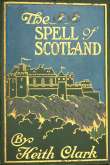
قراءة كتاب The Spell of Scotland The Spell Series
تنويه: تعرض هنا نبذة من اول ١٠ صفحات فقط من الكتاب الالكتروني، لقراءة الكتاب كاملا اضغط على الزر “اشتر الآن"

chance chose for you.
To-day, if you have been gone for two hundred and fifty years, or if you never were "of Scotia dear," except as a mere reading person with an inclination toward romance, you can make harbour after a transatlantic voyage at but one sea-city, and that many miles up a broad in-reaching river. Or, you can come up the English roads by Carlisle or by Newcastle, and cross the Border in the conquering way, which never yet was all-conquering. There is shipping, of course, out of the half hundred old harbours. But it is largely the shipping that goes and comes, fishing boats and coast pliers and the pleasure boats of the western isles.
You cannot come back from the far corners of the earth—to which Scotland has sent such majorities of her sons, since the old days when she squandered them in battle on the Border or on the Continent, to the new days when she squanders them in colonization so that half a dozen of her counties show decline in population—but you must come to Glasgow. The steamers are second-class compared with those which make port farther south. They are slower. But their very lack of modern splendour and their slow speed give time in which to reconstruct your Scotland, out of which perhaps you have been banished since the Covenant, or the Fifteen, or the Forty Five; or perhaps out of which you have never taken the strain which makes you romantic and Cavalier, or Presbyterian and canny. We who have it think that you who have it not lose something very precious for which there is no substitute. We pity you. More clannish than most national tribesmen, we cannot understand how you can endure existence without a drop of Scotch.
Always when I go to Scotland I feel myself returning "home." Notwithstanding that it is two centuries and a bittock since my clerical ancestor left his home, driven out no doubt by the fluctuant fortunes of Covenanter and Cavalier, or, it may be, because he believed he carried the only true faith in his chalice—only he did not carry a chalice—and, either he would keep it undefiled in the New World, or he would share it with the benighted in the New World; I know not.
All that I know is that in spite of the fact that the Scotch in me has not been replenished since those two centuries and odd, I still feel that it is a search after ancestors when I go back to Scotland. And, if a decree of banishment was passed by the unspeakable Hanoverians after the first Rising, and lands and treasure were forfeited, still I look on entire Scotland as my demesne. I surrender not one least portion of it. Not any castle, ruined or restored, is alien to me. Highlander and Lowlander are my undivisive kin. However empty may seem the moorlands and the woodlands except of grouse and deer, there is not a square foot of the twenty-nine thousand seven hundred eighty-five square miles but is filled for me with a longer procession, if not all of them royal, than moved ghostly across the vision of Macbeth.
Nothing happens any longer in Scotland. Everything has happened. Quite true, Scotland may some time reassert itself, demand its independence, cease from its romantic reliance on the fact that it did furnish to England, to the British Empire, the royal line, the Stewarts. Even Queen Victoria, who was so little a Stewart, much more a Hanoverian and a Puritan, was most proud of her Stewart blood, and regarded her summers in the Highlands as the most ancestral thing in her experience.
Scotland may at sometime dissolve the Union, which has been a union of equality, accept the lower estate of a province, an American "state," among the possible four of "Great Britain and Ireland," and enter on a more vigorous provincial life, live her own life, instead of exporting vigour to the colonies—and her exportation is almost done. She may fill this great silence which lies over the land, and is fairly audible in the deserted Highlands, with something of the human note instead of the call of the plover.
But, for us, for the traveler of to-day, and at least for another generation, Scotland is a land where nothing happens, where everything has happened. It has happened abundantly, multitudinously, splendidly. No one can regret—except he is a reformer and a socialist—the absence of the doings of to-day; they would be so realistic, so actual, so small, so of the province and the parish. Whereas in the Golden Age, which is the true age of Scotland, men did everything—loving and fighting, murdering and marauding, with a splendour which makes it seem fairly not of our kind, of another time and of another world.
You must know your Scottish history, you must be filled with Scottish romance, above all, you must know your poetry and ballads, if you would rebuild and refill the country as you go. Not only over fair Melrose lies the moonlight of romance, making the ruin more lovely and more complete than the abbey could ever have been in its most established days, but over the entire land there lies the silver pall of moonlight, making, I doubt not, all things lovelier than in reality.
We truly felt that we should have arranged for "a hundred pipers an' a' an' a'." But we left King's Cross station in something of disguise. The cockneys did not know that we were returning to Scotland. Our landing was to be made as quietly, without pibroch, as when the Old Pretender landed at Peterhead on the far northeastern corner, or when the Young Pretender landed at Moidart on the far western rim of the islands. And neither they nor we pretenders.
 JAMES VI.
The East Coast route is a pleasant way, and I am certain the hundred pipers, or whoever were the merry musicmakers who led the English troops up that way when Edward First was king, and all the Edwards who followed him, and the Richards and the Henrys—they all measured ambition with Scotland and failed—I am certain they made vastly more noise than this excellently managed railway which moves across the English landscape with due English decorum.
We were to stop at Peterborough, and walk out to where, "on that ensanguined block at Fotheringay," the queenliest queen of them all laid her head and died that her son, James Sixth of Scotland, might become First of England. We stopped at York for the minster, and because Alexander III was here married to Margaret, daughter of Henry III; and their daughter being married to Eric of Norway in those old days when Scotland and Norway were kin, became mother to the Maid of Norway, one of the most pathetic and outstanding figures in Scottish history, simply because she died—and from her death came divisions to the kingdom.
We paused at Durham, where in that gorgeous tomb St. Cuthbert lies buried after a brave and Scottish life. We only looked across the purpling sea where already the day was fading, where the slant rays of the sun shone on Lindisfarne, which the spirit of St. Cuthbert must prefer to Durham.
All unconsciously an old song came to sing itself as I looked across that wide water—
"My love's in Germanie,
Send him hame, send him hame,
My love's in Germanie,
Fighting for royalty,
He's as brave as brave can be,
Send him hame, send him hame!"
Full many a lass has looked across this sea and sung this lay—and shall again.
The way is filled with ghosts, long, long processions, moving up and down the land. A boundary is always a lodestone, a lodeline. Why do men establish it except that other men dispute it? In the old days England called it