


قراءة كتاب Our Little Turkish Cousin
تنويه: تعرض هنا نبذة من اول ١٠ صفحات فقط من الكتاب الالكتروني، لقراءة الكتاب كاملا اضغط على الزر “اشتر الآن"
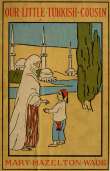

align="left">School
List of Illustrations
| PAGE | |
| Osman | Frontispiece |
| Osman and His Mother | 17 |
| "It looked almost like a fairy city" | 39 |
| "'She told me he would be my husband'" | 58 |
| "Through the crowd of busy people" | 75 |
| "They came in sight of the mosque at last" | 96 |
Our Little Turkish Cousin
CHAPTER I.
Of course Osman cannot remember his first birthday. He is a big boy now, with brown eyes and soft, dark hair. Ten years have rolled over his head since he lay in the little cradle by the side of his mother's grand bedstead.
He made an odd picture,—this tiny baby in cotton shirt and quilted dressing-gown. His head was encased in a cap of red silk. A tassel of seed-pearls hung down at one side. Several charms were fastened to the tassel. His mother thought they would keep harm and danger away from this precious baby boy.
He could not have felt very comfortable. His nurse had straightened out his arms and legs, and bound them tightly with bandages. After dressing him, she placed him in his little bed and covered him with several quilted wrappers. Last of all, a thin, red veil was spread over this little Turkish baby.
Do you think he could have enjoyed himself very much? I don't.
He was ready for visitors now. First of all, the proud and delighted father must come in to see his child. A boy, too! The grave man was doubly pleased when he thought of this. As he looked for the first time upon the tiny form done up in so many wrappers, he could hardly tell whether the boy was big or little, fat or thin.
He bent down over the cradle and lifted the child into his own strong arms. Holding him tenderly, he carried him from the room. He stopped just outside the door. There he stood for a few moments while he repeated a short prayer and whispered the name "Osman" three times in the baby's ear.
This was the only christening the Turkish boy would ever receive. Osman would be his name for the rest of his life; and a fine name it was, his mother and friends all agreed.
When the baby was three days old, there was a grand celebration at his home.
Certain old women, called "bringers of tidings," went from one house to another where the lady friends of Osman's mother had their homes. Wherever they stopped, these old women left bottles of sherbet made of sugar-candy, spices, and water. As they presented the sherbet, they told of the good news about the new baby, of the name his father had given him, and of the feast to be held at Osman's home.
"Do come, do come. You will surely be welcome. You will be glad to see the child and rejoice with his mother."
In this way the invitations were given; and so it happened that many ladies found their way to Osman's house on the day named. No special hour was set for their visit. But, from morning till night, people were coming and going.
It was easy enough for passers-by to know something of interest was taking place inside. They could hear the band of music playing lively airs as the ladies drove up to the door and entered the house.
All the visitors wore long cloaks, with veils over their faces, hiding everything except their soft, dark eyes. For it is still the fashion in Turkey that no lady shall be seen away from her home with her face uncovered.
Very few of these visitors came alone. They were attended by their slaves and servants, laden with baskets. These baskets were very pretty. They were trimmed with flowers and ribbons, and filled with all sorts of delicious sweets.
Of course they were presents for the new baby's mother. She lay in her grand state bed, smiling softly as the ladies came up, one by one, to greet her. Before they entered her chamber, they took off their veils and cloaks in an outside room.
"Mashallah! May the child live long and be happy," said the visitors, as they bent over the young mother. At


