

You are here

قراءة كتاب Punch, or the London Charivari, January 5th, 1895
تنويه: تعرض هنا نبذة من اول ١٠ صفحات فقط من الكتاب الالكتروني، لقراءة الكتاب كاملا اضغط على الزر “اشتر الآن"
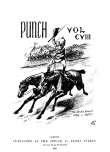

Which plagued us till quite mad we grew
As mad as dog with tongue out.
Those novelties! The newest kind—
With turned up nose and weird, slee-
-py eyes, that told of vacant mind,
And monstrous chignon massed behind—
Were those appalling things designed
By Mr. Aubrey Beardsley.
Yes, "things"; for nought of human shape,
However strangely bizarre,
Is there portrayed; there's not an ape,
That feeds on cocoa-nut or grape,
Between Morocco and the Cape,
So hideous as these are.
For goodness' sake, don't let us see
New Art which courts disaster!
We much prefer to Mr. B.
Velasquez, Rembrandt, even P.
P. Rubens or Vandyke, for we
Like oldness in a master.
And then "New Humour." Heavens, why
It's but a pleasure killer!
A cause of weary yawn and sigh,
Which makes us almost long to fly
To those old jokes collected by
A certain Mr. Miller.
In politics Newcastle, too,
With programme was prophetic;
And now Leeds leads, and shows who's who.
The Grand Old Man—there's age for you!—
Has found much better things to do,
Not prosy but poetic.
But all the things, so new in time,
Are nothing to the woman,
Who now is "new," and seeks to climb
To heights which seem to her sublime;
(Excuse the execrable rhyme)
She is indeed a rum 'un.
Of course we know that youth is sweet;
Old women are not charming;
But no old woman we could meet,
With featless form and formless feet,
This wild New Woman now could beat,
She's perfectly alarming.
Ring out, wild bells, wild belles like these
New-fangled fancies screaming;
Ring in the woman bound to please,
A lady, always at her ease,
Not manlike woman, by degrees
More man that woman seeming.
Old '94, who now has fled,
Encouraged blatant boldness
In things called "new," as we have said;
New '95, now he is dead,
Might bring some things which are instead
Remarkable for oldness.

A VITAL QUESTION.
(Asked at a Penny Reading.)
"Who will stand on either hand,
And keep the bridge with me?"
"SHOULD CHRISTMAS BE ABOLISHED?"
[A symposium on the above question appears in the December Number of The Idler.]
With what philosophy sublime
The institutions are discussed,
Which foolish men of olden time
Were well content to take on trust!
"Is life one great mistake?" we cry,
"Our modern teachers deem it so;"
"Man's place shall woman occupy?"
And now this last—"Shall Christmas go?"
They mock at any plea for mirth,
With fine derision they allude
To any wish for peace on earth
As just a pulpit platitude;
This Christmas-time, it seems, is fraught
With fancies anything but clever;
The lessons that Charles Dickens taught
Are obsolete, and gone for ever!
They tell us, in their stead, to praise
The jokes on seasonable ills,
The epigrams on quarter-days,
The jeux d'esprit on mud and bills;
But as for honest glee and cheer,
Since every cause for joy's demolished,
Why, Christmas, too, it's amply clear,
Should be left out—in fact, "abolished."
Well, let them talk; to please themselves
By all means let them demonstrate
That fairies, Santa Claus, and elves
Are manifestly out-of-date.
Well, let them talk; and find a joy
In cynical philosophy,
But every English girl and boy
Will give their empty words the lie!
Nor only these: In every land
When Christmas brings, to brighten life,
The sturdy grip of hand with hand,
The softened heart, the ended strife,—
Then air your pessimistic views,
Then ask again, "Shall Christmas go?"
And find your answer, if you choose,
In one emphatic, hearty—"NO!"

"Look what I've bought you for a Christmas Box!"
THE CHRONICLES OF A RURAL PARISH.
VIII.—After the Poll.
I am overwhelmed with congratulations, from all classes, from all sections, from all ranks, and I am acclaimed on all hands as a worthy head man for a Mudford, if not yet a model, village. Not the least welcome have been the communications which have reached me from those who have made my acquaintance in these published Chronicles. The mayor of a borough whose charter dates well back into the beginning of the second half of the present century, wrote to say that he is emboldened by the fact that his wife's maiden name commenced with a W to write to tell me how rejoiced he is to hear of my success. A gentleman writes from "The Burning Plains of the Sahara" to say that he is always proud of the triumphs of a Timothy. (My daughter points out that this is clearly a forgery, since the Sahara mail isn't in till next week. But I can't go into that.) Then there is a very important letter from Birmingham, of which I will only say that Winkins, who has backed many a Bill, may yet live to indorse a Programme. I may here add that there has been an attempt in some quarters to decry these Chronicles as absurd and imaginary. My Birmingham correspondent describes them as "an important picture of things as they actually are." He is right. I am as serious as a Prime Minister.
My wife is back—which reminds me that I received a post-card, which his had the effect usually produced by a bomb. Here is what was on it:—
AFTER THE POLL.
After the poll is over,
After the voting's done,
Mudford will be much duller,
No more election fun.
But ONE man will be more happy,
Not so disturbed