

You are here

قراءة كتاب Poeta de Tristibus: Or, the Poet's Complaint
تنويه: تعرض هنا نبذة من اول ١٠ صفحات فقط من الكتاب الالكتروني، لقراءة الكتاب كاملا اضغط على الزر “اشتر الآن"
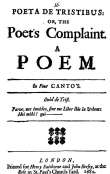

POETA DE TRISTIBUS:
OR, THE
Poet's Complaint
(1682)
Introduction and Notes by
Harold Love
PUBLICATION NUMBER 149
WILLIAM ANDREWS CLARK MEMORIAL LIBRARY
University of California, Los Angeles
1971
GENERAL EDITORS
William E. Conway, William Andrews Clark Memorial Library
George Robert Guffey, University of California, Los Angeles
Maximillian E. Novak, University of California, Los Angeles
ASSOCIATE EDITOR
David S. Rodes, University of California, Los Angeles
ADVISORY EDITORS
Richard C. Boys, University of Michigan
James L. Clifford, Columbia University
Ralph Cohen, University of Virginia
Vinton A. Dearing, University of California, Los Angeles
Arthur Friedman, University of Chicago
Louis A. Landa, Princeton University
Earl Miner, University of California, Los Angeles
Samuel H. Monk, University of Minnesota
Everett T. Moore, University of California, Los Angeles
Lawrence Clark Powell, William Andrews Clark Memorial Library
James Sutherland, University College, London
H. T. Swedenberg, Jr., University of California, Los Angeles
Robert Vosper, William Andrews Clark Memorial Library
Curt A. Zimansky, State University of Iowa
CORRESPONDING SECRETARY
Edna C. Davis, William Andrews Clark Memorial Library
EDITORIAL ASSISTANT
Lilly Kurahashi, William Andrews Clark Memorial Library
List of Contents (created by transcriber)
INTRODUCTION
The Publisher's Epistle to the
The Author's Epistle.
The First CANTO.
The Second CANTO.
The Third CANTO.
The Fourth CANTO.
PRESS VARIANTS
NOTES
REGULAR PUBLICATIONS FOR 1970-1971
SPECIAL PUBLICATION FOR 1969-1970-1971
The Augustan Reprint Society
INTRODUCTION
Poeta de Tristibus: or, the Poet's Complaint (PdT) was published by two newly established booksellers, Henry Faithorne and John Kersey, early in November 1681 (title-page dated 1682). The poem is only one of a large number of Restoration satires on writers as a group, its nearest neighbors in time being the pseudo-Rochester "A Session of the Poets," the anonymous "Advice to Apollo," Mulgrave's "An Essay upon Satyr," Otway's The Poet's Complaint, Robert Gould's "To Julian, Secretary to the Muses," the anonymous "Satire on the Poets," Shadwell's The Tory Poets, and Thomas Wood's Juvenalis Redivivus. It differs from these in its Hudibrastic meter, the richness of its biographical detail, and a relatively mild degree of animus against its victims, though there is quite a deal against poetry as art and trade.
In the two introductory epistles, we are asked to believe first that the poem is the work of a young writer driven into exile by his poverty and secondly that the manuscript was sent from Dover to a relative on 10 January 1681 in acknowledgment of a piece of gold. It is possible, as will be seen, that this reflects an actual history; however, the matter is complicated by the existence of a second text, published by 12 November 1681 (Luttrell's date on his copy, now at Harvard, and apparently the only one still extant) as The Poet's Complaint (PC) in which the story is presented in a slightly different form and the text of the poem is little more than a third the length of PdT. An advertisement placed in Nathaniel Thompson's Loyal Protestant and True Domestick Intelligence on 19 November 1681 claims that the rival version, published by Dan Brown, was printed from a "spurious and very imperfect Copy which contains only the first Part of the said Poem, the three last Parts (which are the most considerable) being wholly left out, excepting some few lines of them foisted in here and there without any Sense or Coherence" and describes the Faithorne and Kersey manuscript as "from the Authors Original Copy in four parts (together with several Additions and Corrections by an Ingenious Person)." In a recent article (PQ, XLVII [1968], 547-562) the present editor has argued against this account of the poem's genesis, and has proposed the following hypothetical order of versions. (For the details of the argument the reader is referred to the article.)
(1) An impromptu written as The Poet's Complaint on or about 30 December 1680, for despatch to "a Person of Quality," using materials from a commonplace book dating from circa 1677. This assumption is based on the terminal dates of its collection of quotations from other writers which differs from that of PdT, and a disparity between the times of composition alleged in the epistles to the two poems—PdT claiming "less than a fortnight's space" and PC "less than three days space."
(2) An enlarged version of #1 in four cantos completed by 10 January 1681. (The "Authors Original Copy.")
(3) The version of #2 revised and augmented by "The Ingenious Person," who may or may not have been identical with the "Publisher," and printed as Poeta de Tristibus.
It would follow that the near-simultaneous publication of versions #1 and #3 in November 1681 was wholly coincidental. My initial assumption that PC represents an early draft rather than a truncated copy of PdT has been reviewed with approval by my colleague