

You are here

قراءة كتاب The Sin and Danger of Self-Love Described by a Sermon Preached At Plymouth, in New-England, 1621
تنويه: تعرض هنا نبذة من اول ١٠ صفحات فقط من الكتاب الالكتروني، لقراءة الكتاب كاملا اضغط على الزر “اشتر الآن"
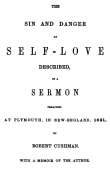
The Sin and Danger of Self-Love Described by a Sermon Preached At Plymouth, in New-England, 1621

prepared for the Plymouth edition, was anonymous. My highly esteemed friend the Rev. Dr. Belknap, in giving it a place in his valuable work was pleased to announce the name of the writer.
The remarks on the discourse originally accompanying the memoir, were prompted by views supposed to have been adopted by the Plymouth pioneers respecting property and civil polity, in which I was afterwards convinced I had made a mistake. I had adopted an opinion corresponding with that of Dr. Robertson and other writers, that misguided by their religious theories and in imitation of the primitive christians, they voluntarily threw all their property into a common stock. And that their difficulties and embarrassments were greatly enhanced by adopting, and perseveringly adhering to an impracticable system. But further inquiry induced the conviction that this conjecture was erroneous, and that the severe pressure they experienced, was in a great degree produced by the operation of their articles of agreement with the adventurers in England, which established a community of interest for seven years, and prevented the holding in severalty the fruits of their industry and enterprise.
These views of the subject, and an acknowledgement of my previous mistake, were expressed in a discourse delivered at Plymouth, in the year 1800, on the anniversary of the landing of the fathers. The Rev. Mr. Abbot of Beverly, afterwards, on a like occasion, without any knowledge of the contents of that discourse, which was not published, was led in his investigation of the subject, into a similar conclusion, and fully vindicated the pilgrims from the censures which had been expressed relative to this branch of their proceedings. The onerous connection with the merchant adventurers remained until 1627, when an amicable and satisfactory settlement was made with them by a purchase of all their interest in the concern. The sum contracted to be given for this purchase, was 1800 pounds sterling, payable by instalments of 200 pounds annually.
Thus says Governor Bradford in one of his letters:
Under these impressions I think it will be well for you to omit the insertion of the remarks above mentioned on Mr. Cushman's discourse. That discourse is a precious relic of ancient times, the sound sense, good advice, and pious spirit, which it manifests, will, it may be hoped, now, and in all future time, meet with approval and beneficial acceptance in our community.
The information contained in the note of your correspondent respecting Mr. Cushman's embarcation, and the assignment of land made to him in the colony, is believed to be correct.
Respectfully Your Ob't. Servant,
J. DAVIS.
To Charles Ewer, Esq.
To his loving Friends the Adventurers for New-England.
TOGETHER
With all Well-Willers, and Well-wishers thereunto, Grace and Peace, &c.
New-England, so called, not only (to avoid novelties) because Captain Smith hath so entitled it in his Description, but because of the resemblance that is in it, of England the native soil of Englishmen; it being much what the same for heat and cold in Summer and Winter, it being champaign ground, but no high mountains, somewhat like the soil in Kent and Essex; full of dales, and meadow ground, full of rivers and sweet springs, as England is. But principally, so far as we can yet find, it is an island, and near about the quantity of England, being cut out from the main land in America, as England is from the main of Europe, by a great arm of the sea, which entereth in forty degrees, and runneth up North West and by West, and goeth out either into the South-Sea, or else into the Bay of Canada. The certainty whereof, and secrets of which, we have not yet so found as that as eye-witnesses we can make narration thereof, but if God give time and means, we shall, ere long, discover both the extent of that river, together with the secrets thereof; and so try what territories, habitations, or commodities, may be found, either in it, or about it.
It pertaineth not to my purpose to speak any thing either in praise, or dispraise of the country; so it is by God's Providence, that a few of us are there planted to our content, and have with great charge and difficulty attained quiet and competent dwellings there. And thus much I will say for the satisfaction of such as have any thought of going hither to inhabit? That for men which have a large heart, and look after great riches, ease, pleasures, dainties, and jollity in this world (except they will live by other men's sweat, or have great riches) I would not advise them to come there, for as yet the country will afford no such matters: But if there be any who are content to lay out their estates, spend their time, labors, and endeavors, for the benefit of them that shall come after, and in desire to further the gospel among those poor heathens, quietly contenting themselves with such hardship and difficulties, as by God's Providence shall fall upon them, being yet young, and in their strength, such men I would advise and encourage to go, for their ends cannot fail them.
And if it should please God to punish his people in the Christian countries of Europe, (for their coldness, carnality, wanton abuse of the Gospel, contention, &c.) either by Turkish slavery, or by popish tyranny which God forbid, yet if the time be come, or shall come (as who knoweth) when Satan shall be let loose to cast out his floods against them, (Rev. 12. 14. 15.) here is a way opened for such as have wings to fly into this wilderness; and as by the dispersion of the Jewish church through persecution, the Lord brought in the fulness of the Gentiles, (Act. 11. 20, 21.) so who knoweth, whether now by tyranny and affliction, he suffereth to come upon them, he will not by little and little chase them even amongst the heathens, that so a light may rise up in the dark, (Luke 2. 32.) and the kingdom of Heaven be taken from them which now have it, and given to a people that shall bring forth the fruit of it. (Mat. 21. 43.) This I leave to the judgment of the godly wise, being neither prophet nor son of a prophet, (Amos 7. 14.) but considering God's dealing of old, (2 Kings 17, 23.) and seeing the name of Christian to be very great, but the true nature thereof almost quite lost in all degrees and sects, I cannot think but that there is some judgment not far off, and that God will shortly, even of stones, raise up children unto Abraham. (Mat. 3. 5.)
And who so rightly considereth what manner of entrance, abiding, and proceedings, we have had among these poor heathens since we came hither, will easily think, that God has some great work to do towards them.
They were wont to be the most cruel and treacherous people in all these parts, even like lions, but to us they have been like lambs, so kind, so submissive, and trusty, as a man may truly say, many christians are not so kind, nor sincere.
They were very much wasted of late, by reason of a great mortality that fell amongst them three years since, which together with their own civil