

You are here

قراءة كتاب A Boy Trooper With Sheridan First Massachusetts Cavalry
تنويه: تعرض هنا نبذة من اول ١٠ صفحات فقط من الكتاب الالكتروني، لقراءة الكتاب كاملا اضغط على الزر “اشتر الآن"
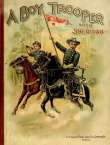
A Boy Trooper With Sheridan First Massachusetts Cavalry

A BOY TROOPER WITH SHERIDAN
By Stanton P. Allen
First Massachusetts Cavalry
Boston
Lothrop Publishing Company
1899,

CONTENTS
CHAPTER I.
More than He Bargained for—The War Fever and How it Affected the Boys—A Disbanded Cavalryman—Going to School in Uniform—Cousin Tom from Shiloh?—Running Away to Enlist—The Draft—In the Griswold Cavalry—Habeas Corf used.

N the local columns of the Troy (N. Y.) Daily Times of September 1, 1863, the following news:
MORE THAN HE BARGAINED FOR.
"A few days ago one Stanton P. Allen of Berlin, enlisted in Capt. Boutelle's company of the twenty-first (Griswold) cavalry. We are not informed whether it was Stanton's bearing the same name as the Secretary of War, or his mature cast of countenance that caused him to be accepted; for he was regarded as nineteen years of age, while, in reality but fourteen summers had passed over his youthful, but ambitious brow. Stanton received a portion of his bounty and invested himself in one of those 'neat, but not gaudy' yellow and blue suits that constitute the uniform of the Griswold boys. A few days intervened. Stanton's 'parients,' on the vine-clad hills of Berlin, heard that their darling boy had 'gone for a sojer.' Their emotions were indescribable. 'So young and yet so valiant,' thought his female relatives. 'How can I get him out?' was the more practical query of his papa. The ways the ways and means were soon discovered. A writ of habeas corpus was procured from Judge Robertson, and as the proof was clear that Stanton was only fourteen years old, he was duly discharged from the service of the United States. But the end was not yet. A warrant was issued for the recruit, charging him with obtaining bounty and uniform under false pretenses, and a release from the military service proved only a transfer to the civil power. Stanton found that he had made a poor exchange of 'situations,' and last evening gave bail before Judge Robertson in the sum of five hundred dollars."
In order that the correctness of history may not be questioned, the subject of the above deems it expedient to place on record an outline of the circumstances leading up to the incident related by the Times.
At the breaking out of the war my father resided in Berlin, N. Y., on the Brimmer farm, three miles or so from the village. I was twelve years old, but larger than many lads of sixteen. I was attacked by the war fever as soon as the news that Fort Sumter had been fired on reached the Brimmer farm. Nathaniel Bass worked for my father that year. The war fever got hold of Nat after haying was over, and one night along in the latter part of August, he said to me:
"I'm going to war."
"You don't mean it, Nat?"
"Yes, I do. The fall's work won't last long, and they say they're paying thirteen dollars a month and found for soldiers. That's better'n doing chores for your board."
"If you do go I'll run away and enlist."
"No; you're too young to go to war. You must wait till you're an able-bodied man-that's what the bills call for."
"O, dear! I'm afraid you'll whip all the rebels before I can get there."
I cried myself to sleep that night.
How I envied Nat when he came home on a three days' furlough clad in a full suit of cavalry uniform! He enlisted September 20, 1861, in the Second New York cavalry. The regiment was known as the Northern Black-horse cavalry. Nat allowed me to try on his jacket, and I strutted about in it for an hour or so. I felt that even in wearing it for a short time I was doing something toward whipping the Southerners. But Bass's furlough came to an end, and he returned to his regiment.
Nat came back in time to help us plant in the spring of 1862. The regiment went as far as Camp Stoneman, near Washington, where it remained in winter quarters. It was not accepted by the United States Government, and was never mounted. The reason given was that the Government had more cavalry than it could handle, and the Northern Black-horse cavalry was disbanded. The regiment was raised by Colonel Andrew J. Morrison, who subsequently served with distinction at the head of a brigade.
Nat came home "chock-full" of war stories. He was just as much a hero in my estimation as he would have been if the rebels had shot him all to pieces. I never tired of listening to his yarns about the experiences of the regiment at Camp Stoneman. He had not seen a rebel, dead or alive, but that was not his fault. Nat was something of a singer, and he had a song