


قراءة كتاب The History of the Revolutions of Portugal
تنويه: تعرض هنا نبذة من اول ١٠ صفحات فقط من الكتاب الالكتروني، لقراءة الكتاب كاملا اضغط على الزر “اشتر الآن"
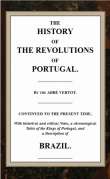

THE
HISTORY
OF
THE REVOLUTIONS
OF
PORTUGAL.
By the ABBÉ VERTOT.
CONTINUED TO THE PRESENT TIME,
With historical and critical Notes, a chronological
Table of the Kings of Portugal, and
a Description of
BRAZIL.
By LOUIS DE BOISGELIN,
CHEVALIER DE MALTHE.
Extractum Lustris, primo Viriathus in ævo
Nomen Romanis factum mox nobile Damnis.
Silius Ital. de Bell. Pun. Lib. 3.
LONDON:
Printed by and for R. Juigné, No. 17, Margaret-street,
Cavendish-square.
Sold by Longman, Hurst, Rees, and Orme,
Paternoster-row.
——
1809.
PREFACE.
THE study of modern history has been, during a long course of years, greatly neglected in the generality of public schools; but it now begins to be regarded (as indeed it ought always to have been) as an object of the greatest importance. In England, particularly, it constitutes one of the principal branches of both public and private education.
The abbé de Vertot’s History of the Revolutions of Portugal has been always esteemed equally entertaining and instructive; and as such more especially calculated for the use of young people. The late events in that country has made it doubly interesting, and nothing now seems wanting to complete so excellent a performance, but to continue the narrative to the present period. This, however, if accurately given, would greatly exceed the limits we propose to ourselves in this little Work: to others, therefore, must we leave so laborious a task, and merely content ourselves with presenting to the public the annals of Portugal, from the war which the Portugueze term that of the acclamation, to the battle of Veimera. We cannot even pretend to take notice of several of the principal events which happened during that space of time, though we have been particularly attentive in investigating those which have given rise to, and ended in revolutions. We have also endeavoured to give a just idea of the character of the different kings of Portugal, with the talents of the ministers who have defended the royal authority, and the qualities of those who have attacked it.
In regard to the revolution which lately threatened the total annihilation of the throne of Portugal; the events which occasioned it, and those which have happily stopped its progress, are so recent, and so known, that we thought it needless to enter upon the subject.
Such has always been our respect for Vertot, that we have never presumed to interrupt the course of his narrative; except, indeed, the very few notes we have ventured to add, may be liable to such an interpretation.
This celebrated author having passed over in silence many of the monarchs who reigned in Portugal, previous to the revolution he so particularly described, we have added a chronological and historical Table of the different kings from Henry of Burgundy, count of Portugal, to John the IVth, duke of Braganza. We have likewise joined an accurate, historical and critical Catalogue, not only of the works of the greater part of the authors quoted by Vertot in his notes, (whose names he only mentions) but of all the most important books since published relative to Portugal and its colonies.
The recent departure of the family of Braganza from Lisbon, and their arrival in Brazil, has called for the attention, and interested the minds of every one. We have therefore been tempted to give a slight sketch of a country which is now become an object of no small curiosity: to which we have added, for the satisfaction of those readers who may be desirous of a more minute description, a list of the principal authors who have made this beautiful, though remote part of the new world, the particular object of their attention.
AN
ACCURATE, HISTORICAL, AND CRITICAL
CATALOGUE
Of the principal Works published relative to the History of Portugal.
Résendius (Andrew, or Louis Andrew). John the IIId appointed him to superintend the education of his two brothers. He published two works, which are much esteemed: the first entitled, de Antiquitatibus Lusitaniæ, (printed in folio at Evora, in 1593); and the second, Deliciæ Lusitano-Hispanicæ. His brother Garcias published a folio History of John the IIId, in Portugueze.
Vasconcellos (Antonio) has published different works. One of the most esteemed is entitled, Anacephalosis id est summa Capita actorem regum Lusitaniæ.
Texeira (Joseph) embraced the cause of the king, don Antonio, and followed him to France, where he was greatly favoured by Henry the IIId, and Henry the IVth. His work, called Portugaliæ Ortu, is not in very great repute.
Faria (de Sousa Emmanual) was born in 1610, and died in 1659. His narratives are more eloquent than historical; he exhausts himself in harangues and reflexions, treating the greatest and the most trifling events with the same degree of importance. His principal characters are always heroes, and never men. His most celebrated work is divided into three parts; the first, containing the ancient history of Lusitania; the second, the conquests made by the Portugueze in Asia, and the eastern parts of Africa; and the third, the wars which took place in that part of Africa which is opposite to Andalusia, and the kingdom of Algarva. This work is curious and accurate, and has been translated into Italian, French, and English. The same author has published a history of Portugal, terminating at the reign of cardinal Henry. It has gone through several editions; the best of which was printed in folio, in 1730, and is continued to a later epoch.
Brito (Bernard de) a cistercian monk, historiographer of Portugal, was born in 1569, and died in 1612. He published the Monarchia Lusitana, 7 vols. in folio, Lisbon, 1597, and 1612. This is a history of Portugal which goes back as far as count Henry, and is elegantly written. Father Antonio, and father Francisco Brandhamo, members of the same society, have continued this history to the reign of Alphonso the IIId. The two first volumes alone were written by Brito, who, however, was the author of the Panegyrics of the Kings of Portugal, with their Portraits; and also of the Ancient Geography of Portugal. There is likewise another Brito, (Francisco) who wrote Guerra Brasilica, in 2 vols. folio, printed at Lisbon in 1675.
Brandhamo, and his continuator, have only given a description of the events which took place in Portugal from the usurpation of Philip the IId to the revolution, with the consequences which attended it in the reign of Philip the IVth.
Birago, of the order of Malta, has written on the same subject. Brandhamo wishing to adopt great simplicity of style, becomes very dry, and sinks into a mere newspaper writer; whilst Birago writes with more spirit, his style is more equal, his reflexions lively and ingenious, and his characters and