

You are here

قراءة كتاب The Book of Vagabonds and Beggars with a Vocabulary of Their Language
تنويه: تعرض هنا نبذة من اول ١٠ صفحات فقط من الكتاب الالكتروني، لقراءة الكتاب كاملا اضغط على الزر “اشتر الآن"
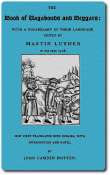
The Book of Vagabonds and Beggars with a Vocabulary of Their Language

editions, is embellished with a woodcut,—a facsimile of which is given in this translation. The picture, representing a beggar and his family, explains itself. At the foot of the title is printed, in black:—Getrucht zu Augspurg durch Erhart Öglin. The little book was frequently reprinted without any other variations than printers’ blunders (one edition having an error in the first word, Lieber Vagatorum) until 1528, when Luther edited an edition,5 supplying a preface, and correcting some of the passages. In 1529 another edition, with Luther’s preface, appeared at Wittemberg,6 and from this, comparing it occasionally with the first Pg xviiedition by Ocellus, the present English version has been made. Nearly all the editions contain the same matter; nor do those issued under Luther’s authority furnish us with additional information. With regard to the Vocabulary, however, I have made, in a few instances, slight variations, as given in two editions of the Liber Vagatorum, preserved in the Library at Munich. Wherever there was a marked divergence in style I have adopted that as my text which seemed to be the most characteristic for the fifteenth and the commencement of the sixteenth centuries, and which is mostly to be found in the better class MSS. and works of that period.
I should state, however, before proceeding further, that a metrical version of the Liber Vagatorum, in 838 verses, appeared about 1517-18, written by Pamphilus Gengenbach, including a vocabulary of the beggars’ cant. Although Karl Gödecke, in his work, Ein Beitrag zur Deutschen Literatur Geschichte der Reformations zeit (Hannover, Carl Rümpler, 1855), has stated that Gengenbach’s poetical version preceded the smaller prose account, it is impossible, upon examining the two publications, to agree with him on this point. Gengenbach’s book certainly did not appear till after 1517, and the direct copies from the Liber Vagatorum, in matter and manner, are too frequent to admit for one moment of the supposition of their being accidental. The cant terms, too, are incorrectly given, and altogether the work bears the appearance of hasty and piratical compilation. It never met with that popularity which the author anticipated, and probably never crossed the frontiers of Switzerland.
The latest prose edition of the Liber Vagatorum was issued towards the close of the seventeenth century. The title ran:—Expertus in truffis. Of False Beggars and their knaveries. A pretty little book, made more than a century and a half since, together with a Vocabulary of some old cant words that occur therein, newly edited. Anno 1668 (12o. pp. 160).
MARTIN LUTHER
 HAT Luther should have written a Preface to so undignified a little work as The Book of Vagabonds seems remarkable. At this period (1528-9) he was in the midst of his labours, surrounded with difficulties and cares, and with every moment of his time fully occupied. The Protest of Spires had just been signed by the first Protestants. Melancthon, in great affliction at the turbulent state of affairs, was running from city to city; and all Germany was alarmed to hear that the dreaded Turks were preparing to make battle before Vienna. Yet, the centre of all this agitation, engaged in directing and assisting his followers, Luther found time to write several popular pieces, and kept, we are told, the book-hawkers of Augsburg and Spires busy in supplying them to the people. These Christian pamphlets, D’Aubigné informs us, were eagerly sought for and passed through numberless editions. It was not the peasants and townspeople only who read them, but nobles and princes. Luther intendedPg xx that they should be popular. He knew better than any man of his time how to captivate the reader and fix his attention. His little books were short, easy to read, full of homely sayings and current phrases, and ornamented with curious engravings. They were generally written, too, in Latin and German, to suit both the educated and the unlettered. One was entitled, The Papacy with its Members painted and described by Dr. Luther. In it figured the Pope, the cardinal, and all the religious orders. Under the picture of one of the orders were these lines:—
“Not one of these orders,” said Luther to the reader, “thinks either of faith or charity. This one wears the tonsure, the other a hood, this a cloak, that a robe. One is white, another black, a third gray, and a fourth blue. Here is one holding a looking-glass, there one with a pair of scissors. Each has his playthings.... Ah! these are the palmer-worms, the locusts, the canker-worms, and the caterpillars which, as Joel saith, have eaten up all the earth.”7
In this style Luther addressed his readers—scourging the Pope, his cardinals, and all their emissaries. But another class of “locusts” besides these appeared to him to require sweeping away,—these were the beggars and vagabonds who imitated the Mendicant Friars in wandering up and down the country, with lying tales of distress, either of mind or body. As he says in his Preface, explaining the reason of his connection with the book, “I thought it a good thing that such a work should not only be published, but that it should become known everywhere, in order that men can see and understand how mightily the devil rules in this world; and I have also thought how such a book may help mankind to be wise, and on the look out for him, viz. the devil.”
Luther further adds—not forgetting, in passing, to give a blow to Papacy—“Princes, lords, counsellors of state, and everybody should be prudent, and cautious in dealing with beggars, and learn that, whereas people will not give and help honest paupers and needy neighbours, as ordained by God, they give, by the persuasion of the devil, and contrary to God’s judgment, ten times as much to vagabonds and desperate rogues,—in like manner as we have hitherto done to monasteries, cloisters, churches, chapels, and Mendicant Friars, forsaking all the time the truly poor.”
This was Luther’s object in affixing his name to the little book. He saw that the Friars, Beggars, and Jews were eating up his country, and he thought that a graphic account of the various orders of vagrants, together with a list of their secret or cant words, issued under the authority of his name, would put people on their guard, and help to suppress the wretched system.
Luther’s statement as to his own experience with these rogues is very naïve—“I have myself of late years,” he remarks, “been cheated and slandered by such tramps and liars more than I care to confess.”
Both priests and beggars regarded him with a peculiar