

You are here

قراءة كتاب Motor Matt's Peril, or, Cast Away in the Bahamas Motor Stories Thrilling Adventure Motor Fiction No. 12, May 15, 1909
تنويه: تعرض هنا نبذة من اول ١٠ صفحات فقط من الكتاب الالكتروني، لقراءة الكتاب كاملا اضغط على الزر “اشتر الآن"
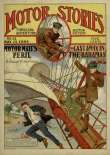
Motor Matt's Peril, or, Cast Away in the Bahamas Motor Stories Thrilling Adventure Motor Fiction No. 12, May 15, 1909

dog.
The Italian had been cooking the "red-hots" on a steel plate. The plate, of course, was hot, and it struck the dog. There came a yelp of pain, and the dog tore out from under the cart and hustled back toward the photograph instrument.
The Italian had changed his tune. He was not laughing, now, but was prancing around and howling frantically for the police.
"Sacre diabolo estrito crystal!" he shrieked. "You wreck-a da wag'—you spoil-a da bun, da red-a-hot! Polees! Me, I like-a keel-a you! Polees! polees!"
While he yelled, he started angrily toward Carl. The Dutch boy, whirling the overturned cart around, caused the Italian to stumble over it. Leaving him to writhe and sputter among the scattered buns and "wienes," Carl raced on toward the steel pier.
He was flattering himself that he would be able to regain the bathhouse without further molestation, but in this he was mistaken. An officer jumped down from the side of the pier, as he came close to it, and grabbed him by the arm.
"Not so fast, there!" cried the policeman.
"Vat's der madder mit you?" wheezed Carl. "I don'd vas doing anyt'ing."
"Oh, no," was the sarcastic response, "you wasn't doing a thing! What did you kick over that dago's cart for?"
"Dose fellers hat set a dog on me!" cried Carl. "Ditn't you see der dog?"
Just then the Italian, two of the pirates and one of the men with the photographic apparatus, hurried up, all in a crowd.
"Pinch-a heem!" fumed the Italian; "he make-a plenty da troub'!"
"He's the original Buttinsky," scowled the picture man. "He pushed into that moving picture, spoiled a lot of film and made it necessary for us to do our work all over."
"He's the prize idiot, all right!" clamored one of the pirates.
"What's the matter, here?" demanded a voice, as a youth pushed into the crowd and ranged himself at the Dutch boy's side. "What's the matter, Carl?"
"Modor Matt!" exclaimed Carl, gripping the newcomer's arm. "You haf arrifed py der nick oof time, like alvays! Now, den," and here Carl faced the others belligerently, "my bard has come, und you vill haf to make some oxblanadions. Vat haf you got to say for yourselufs?"
CHAPTER II.
THE MOVING-PICTURE MAN MAKES A QUEER MOVE.
A little farther along the beach, and well out of the way of high tide, four heavy posts had been planted in the sand. This was the mooring-place for the "Hawk," the famous air ship belonging to Matt and Dick Ferral, and which the three chums had brought from South Chicago.
The boys had had the Hawk in Atlantic City for two weeks, making four flights every day except on Sunday, or on days when high winds or stormy weather prevailed. There had been only one stormy day when it had been found necessary to house the Hawk under the roof of one of the piers, and only one other day when the wind had been so strong as to make an ascent too risky.
Four passengers were carried aloft in each flight. Six persons were all Matt thought advisable to take up in the air ship, and of course he had to go along to take charge of the motor, and with him went either Dick or Carl to act as lookout and "crew." A charge of $25 was made for each passenger, and the flights had so captured the fancy of wealthy resorters that the boys had advance "bookings" that promised to keep them in Atlantic City all the summer. With $400 a day coming in, and a very small outgo for expenses, the chums were making money hand over fist.
On the afternoon when Carl was taking his dip in the ocean, and incidentally spoiling films for the moving-picture people, Matt and Dick, with their usual four passengers, had been making their last flight of the day over Absecon Island and the eastern coast of New Jersey.
One of the passengers on that trip was a Mr. Archibald Townsend, of Philadelphia. Passengers always showed a great interest in the air ship, but Mr. Townsend had shown more curiosity and had asked more questions than any of the others.
As Matt and Dick were bringing the Hawk down to the beach, they had witnessed the overturning of the Italian's "red-hot" outfit, and had seen Carl get clear of the wreck and race on toward the steel pier. Leaving Dick to make the air ship secure in her berth, Matt had tumbled out of the car and hurried after Carl. As we have already seen, the young motorist reached his Dutch chum just as the officer had laid hold of him.
The officer's name was McMillan, and he was arrogant and officious to a degree. He had been on duty along that part of the board walk ever since the chums had reached Atlantic City, and he had interfered with their operations to such an extent that Matt had found it necessary, on one occasion, to report him. On this account, McMillan was not very amiably disposed toward the young motorist and his friends.
"I don't care who this fellow is," growled the officer, nodding his head toward Carl, "no one can come here an' raise hob on the beach without bein' jugged for it. I saw what happened. The Dutchman knocked over the dago's cart."
"Dot feller," and here Carl pointed to the moving-picture man, "set der dog on me. Oof I hatn't knocked ofer der cart, der dog vould haf got me sure. Vat pitzness he got setting der dog on me, hey? He iss to plame, yah, dot's righdt."
"What did you want to butt into our picture for?" demanded the photographer.
"How I know you vas daking some mooting bictures?" demanded Carl. "I see dot young laty on der peach, und she vas in some greadt drouples; den I see dem birate fellers in der poat, going afder her, und nopody vould run mit demselufs to der resgue. Den I go. You bed my life, no laty vat iss in tisdress can be dot vay ven I vas aroundt."
"We'll have to do our work all over again to-morrow afternoon," went on the moving-picture man, "and I have to pay these actors more money for another afternoon's work."
"How much will that be?" asked Matt, who saw very clearly that Carl had made a mistake and was in the wrong.
"There are six of 'em," replied the photographer, "and I pay them ten dollars apiece."
"That makes sixty dollars," said Matt, "and I'll——"
"Just a minute, King." It was Mr. Townsend who spoke. He had hurried toward the scene of the dispute and had arrived in time to hear the moving-picture man's explanation and Matt's offer to foot the bill. "This fellow's name is Jurgens," continued Mr. Townsend. "He comes from Philadelphia, and I happen to know that he gives these actors five dollars apiece for their work. If you give him just half of what he asks, King, you will be treating him fairly."
Jurgens glared at Townsend.
"What business have you got interfering here?" he asked, angrily.
"I am merely interfering in the interests of justice, that's all," replied Townsend, coolly, "and because I think you an all-around scoundrel, Jurgens. You and I have had some dealings already, you remember."
A black scowl crossed Jurgens' face.
"And our dealings are not finished yet, by a long shot," returned Jurgens.
Townsend tossed his hands contemptuously and turned his back on the photographer.
"I'll have my sixty dollars," cried Jurgens, to Matt, "or there'll be trouble."
"You'll take thirty," said Matt, taking some money from his pocket and offering it, "and not a cent more."
Jurgens struck aside the hand fiercely.
"This dago is the boy that interests me," said the officer. "He's a poor man an' can't afford to have his stock in trade ruined by that Dutch lobster."
At this, Carl fired up.
"Who you vas galling a Dutch lopsder?" he demanded, moving truculently in the direction of McMillan.
"You!" snorted the officer, dropping a hand on his club.
Carl let fly with his fist. Matt grabbed the arm just in time to counter the blow.