

You are here

قراءة كتاب The Old House and Other Tales
تنويه: تعرض هنا نبذة من اول ١٠ صفحات فقط من الكتاب الالكتروني، لقراءة الكتاب كاملا اضغط على الزر “اشتر الآن"
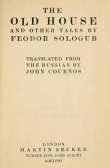

THE OLD HOUSE
AND OTHER TALES
BY
FEODOR SOLOGUB
AUTHORISED TRANSLATION FROM THE RUSSIAN
BY JOHN COURNOS
SECOND IMPRESSION
LONDON
MARTIN SECKER
NUMBER FIVE JOHN STREET
ADELPHI
1916
Acknowledgments are due to the Editor of The New Statesman for permission to republish The White Dog and The Hoop, which first appeared in that periodical.
CONTENTS
THE OLD HOUSE
THE UNITER OF SOULS
THE INVOKER OF THE BEAST
THE WHITE DOG
LIGHT AND SHADOWS
THE GLIMMER OF HUNGER
HIDE AND SEEK
THE SMILE
THE HOOP
THE SEARCH
THE WHITE MOTHER
INTRODUCTION
"Sologub" is a pseudonym—the author's real name is Feodor Kuzmich Teternikov. He was born in 1863. He completed a scholastic course at Petrograd. His first published story appeared in the periodical "Severny Viestnik" in 1894, but it was not until about a dozen years later that he came into his fame, which he has since then further enhanced.
This is all the biographical knowledge we have of a living novelist whose place in Russian literature is secure beyond all question; the scantiness of our knowledge is all the more amazing when we consider that the author is over fifty, and that his complete works are in their twentieth volume.
These include almost every possible form of literary expression—the fairy tale, the poem, the play, the essay, the novel, and the short story. Sologub's place as a poet is hardly less assured than his place as a novelist.
How little importance Sologub attaches to personal réclame may be gathered from his answer to repeated requests for a nutshell "autobiography" a type of document in vogue in Russia; Maxim Gorky's impressive model, I believe, is quite familiar to English readers.
"I cannot give you my autobiography," Sologub wrote to the editor of a literary almanac, "as I do not think that my personality can be of sufficient interest to any one. And I haven't the time to waste on such unnecessary business as an autobiography."
At the beginning of his Complete Works, however, there is a poem in prose, a kind of spiritual autobiography in which he insists that all life is a miracle, and that his own surely is also. "I simply and calmly reveal my soul ... in the hope that the intimate part of me shall become the universal." After such an avowal the reader will know where to look for the author's personality.
In studying his work, one finds that he has both realism and fantasy. But while he is sometimes wholly realistic, he is seldom wholly fantastic. His fantasy has always its foundations in reality. His realism is as grey as that of Chekhov, whose logical successor he has been acclaimed by Russian criticism. But it is his prodigious fantasy that makes the point of his departure from the Chekhovian formula. When he combines the two qualities, the strange reconciliation thus effected produces a result as original as it is rich in "the meaning of life." Sologub himself says somewhere:
"I take a piece of life, coarse and poor, and make of it a delightful legend."
This sentence establishes the distinction between the two writers. Life for Chekhov may contain its delightful characters, life itself is seldom a delightful legend.
Actually, Sologub sees life more greyly than Chekhov; perhaps it is this sense of grief "too great to be borne" that compels him to grope for an outlet, for some kind of relief. Already in his earliest novel one of the characters gives utterance to the significant words:
"Once you prove that life has no meaning, life becomes impossible."
This relief is to be found within oneself in the "inner life"; that is in the imagination, "imagination the great consoler" as Renan has said. Imagination is everything; it is, indeed, the invoker of all beauty; and admiration of beauty is the one escape out of life. The author, "with whatever words he can find, speaks of one thing. Patiently calls towards the one thing...." Writing of the sadness of life, he envelops this sadness in the beauty evoked by his imagination as in a flame, and withers it up. One finds him rejoicing that there is a life other than "this ordinary, coarse, tedious, sunlight life," that there is a life that is "nocturnal, prodigious, resembling a fairy tale."
It may sound like a startling antinomy to say that at his happiest Sologub is a compound of Chekhov and Poe. It could be put in another way: if Poe were a Russian, he might have written as Sologub writes. This is to say that the mystery with which Sologub endows his tales is never there for its own sake, but as a most intense symbol of reality.
Consider a story like "The Invoker of the Beast." As a story of reincarnation it is a masterpiece of mystery. The reader, anxious for a good tale merely, may let the matter rest there. But can he? Can he listen to Gurov, who, while living through, in his delirium, his previous existence, is so insistent about the "invincibility of his walls"—and yet remain unmoved to the deep meaning of Gurov's cry? Are not the seemingly imperishable walls, within which Gurov thought himself secure from the Beast, a symbol of our own subtle insecurity? Is not our own Beast—be it some unexpected latent circumstance, or some unlooked-for yet inevitable consequence of a past action, on the part of our ancestors or of ourselves—ready to pounce upon us and ravage our hearts, after a long and relentless pursuit, from which in the end there is no escape?
Again, to one who has read most of Sologub's productions, the story of the Beast is interesting, because it contains, as it were, a synthesis of the author's tendencies. Its separate motifs are repeated in variation in many of his other stories. There is the boy Timarides, whom the author loves. Why?
Because Timarides is a child, because he is beautiful, trustful, and ready to do daring deeds. Timarides perhaps stands