

You are here

قراءة كتاب The Girl's Own Paper, Vol. XX, No. 981, October 15, 1898
تنويه: تعرض هنا نبذة من اول ١٠ صفحات فقط من الكتاب الالكتروني، لقراءة الكتاب كاملا اضغط على الزر “اشتر الآن"
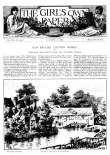
The Girl's Own Paper, Vol. XX, No. 981, October 15, 1898

THE GIRL'S OWN PAPER

| Vol. XX.—No. 981.] | OCTOBER 15, 1898. | [Price One Penny. |
[Transcriber's Note: This Table of Contents was not present in the original.]
OLD ENGLISH COTTAGE HOMES.
HOUSEHOLD HINTS.
"OUR HERO."
LESSONS FROM NATURE.
ABOUT PEGGY SAVILLE.
HAWKWEED.
IN THE TWILIGHT SIDE BY SIDE.
QUEENS AS NEEDLEWOMEN.
WHERE SWALLOWS BUILD.
ANSWERS TO CORRESPONDENTS.
THE GIRL'S OWN QUESTIONS AND ANSWERS COMPETITION.
ENTHUSIASM: AN ADDRESS TO SCHOOL-GIRLS.
OLD ENGLISH COTTAGE HOMES;
OR,
VILLAGE ARCHITECTURE OF BYGONE TIMES.

All rights reserved.]
As our papers upon "The Characteristic Church Towers of English Counties" appear to have interested our readers, it is possible they may be willing to peruse these remarks upon the old dwellings, and some other objects which surround country churches.
We fear there can be no doubt that our village architecture has deteriorated, and that the cottage of to-day is scarcely, if ever, as beautiful as that of former times.
Nor is this our only cause for regret, for, unfortunately, our beautiful old village architecture is disappearing so rapidly, that it is to be feared there will be nothing left to convey to the minds of those who come after us any idea of its charm.
When one speaks of "English villages," it is advisable to point out that those small country towns which are erected after the same manner and method are included; that is to say, those which are contained in one single parish, and which possess houses of small scale with rustic adjuncts, gardens, orchards, farm-buildings, etc. There is architecturally no difference between a village and a town of this description. It makes no difference whether the houses are built in rows or are detached. The beautiful village of Ayot St. Lawrence, in Hertfordshire, has houses arranged in rows, and so had Eaton, in Norfolk, before its rebuilding some years back. The notion that country houses should always be detached, or semi-detached, has led to much injudicious arrangement in suburban building estates. If there is land to spare, isolate your houses, but if not, no good end is answered by detaching them so as to leave wretched narrow passages between them, which are always damp, gloomy, and too frequently become receptacles for disused and broken articles, which would be far better put on the fire or given to the dustman. If houses are detached, or semi-detached, there should always be a space twelve or fifteen feet between them (unless, of course, the houses are very low), otherwise the rooms bordering upon the opening are damp and cold.

English country towns differ completely from continental ones chiefly for this reason. On the Continent, towns were nearly always fortified and surrounded by walls, though often their population was that of a mere village. These little fortified places are in Germany called "dwarf cities," to distinguish them from the "dorf," or "village." In England, however, small towns were rarely fortified or walled, except when they were situated upon the sea-coast, where they had to be ready to resist the landing of some foreign enemy. Lyme-Regis, Dorsetshire, is an example of a small English fortified town, and it is quite strange how much the place (of course we refer to the old portions of it) impresses one with its continental aspect, because directly a town is "circumvallated," every building within it has to be erected upon a contracted space, and the houses are consequently developed in height, so that they in no way differ from those of a city; in fact, the small town might, architecturally, be a piece of some large city.
Such English towns as Amersham, Lavenham, Clare, Wheathamstead, etc., are, architecturally, large villages, and probably originated in the same manner—i.e., they were dependencies upon some lordship or monastery.
The English word "village" is derived from the Roman word "villa." The villa was the castle or manorial house of the proprietor of the land surrounded by a series of humble structures inhabited by his labourers and "serfs." This was the "village" or dependency of the villa, and hence its inhabitants were called "villains" (villani). Now we are aware that some modern writers attempt to derive these words from the German "wealh" (a welchman), yet the old and usually received idea seems so obvious that we accept it.
How the meaning of the words "villa" and "villain" have been changed, and yet how singularly the old word "village" has retained its meaning!
The modern stucco, semi-detached "desirable residence," with its four or six rooms, with its "rustic porch" and gritty front garden, is a strange parody upon the stately villa of old, and the good, honest villager is neither a "villain" nor "a Welshman." He may