

You are here

قراءة كتاب The Girl's Own Paper, Vol. XX, No. 983, October 29, 1898
تنويه: تعرض هنا نبذة من اول ١٠ صفحات فقط من الكتاب الالكتروني، لقراءة الكتاب كاملا اضغط على الزر “اشتر الآن"
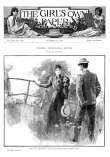
The Girl's Own Paper, Vol. XX, No. 983, October 29, 1898

meet a gentleman. It was a mistake to trust a young fellow with that flighty chestnut; in Bower's opinion the groom was as bad a whip as he had ever seen. On the way back the mare had bolted; both the men were flung out, but it was the gentleman who was hurt—very badly hurt, it was feared. They had got him to bed at the Hall, and the doctor would stay with him far into the night.
A woman, pale and sorrowful, knelt alone in her room, with her face uplifted to the stars. "If it had not been for me, he would not have come back! Oh, God, spare his life," she prayed. "Spare him, and let the way be made clear for my feet!"
Days came and went—brilliant days, full of summer sweetness and bloom, but Cardigan lay crushed and helpless at the squire's house. He was a lonely man. There was neither mother nor sister to share the nurse's watch in the sick room; but when the news of the disaster came to Mary de Vigny's ears, she wrote to the Monteagles and said that she was coming. She arrived, quiet and self-possessed as ever; and with her presence came a gleam of hope and light. The patient began to rally. Very slowly, very feebly, he seemed to feel his way back into life.
One evening Mary de Vigny sent a note to Swallow's Nest. The squire himself was the bearer. He drove to the gate in his wife's pony-cart, and waited till Miss Harper was ready to go up to the Hall.
Cardigan, propped up on his pillows, motionless and pale, brightened wonderfully when she entered the room.
"Ah, I knew you would come," he said. "I could not lie here any longer without seeing you, and hearing your voice. Do you believe in me yet, Alice? Is there any more hope for me now than there was last year?"
"Hush," she said gently. "You are not well enough to talk about these things."
"I shall never get well till I have talked about them! Alice, I want to tell you that I made my will after I saw you last. I left you Swallow's Nest, and everything else besides. Perhaps I had better die, for you will know what to do with the money. A man's life, after all, is a little thing, and I never was good enough for you. If I die——"
"Hush," she said again. "If you die, I will never marry anyone else as long as I live. But you mustn't die."
She burst into tears; and then his hand stole along the coverlet until it found hers, and held it fast.
[THE END.]

OUR PUZZLE POEM REPORT: A SHORT STORY IN VERSE.
SOLUTION.
A Short Story in Verse.
Was once taking a walk,
When he met with a rusty old nail;
And, being in the mood
For a mouthful of food,
He waggled the tip of his tail.
"I can very well dine
"Off this small but acceptable bone;"
But when he had dined
He more sagely opined,
"I wish I had let it alone!"
Prize Winners.
Twelve Shillings and Sixpence Each.
- Rose S. Bracey, 92, Upper Tollington Park, N.
- Mrs. J. Cumming, 1, Elvan Terrace, Ibrox, Glasgow.
- Rose D. Davis, St. Georges, Roundhay, Leeds.
- Mrs. Grubbe, Mentmore Vicarage, Leighton Buzzard.
- J. Hunt, 42, Francis Road, Birmingham.
- Edith Morrison, 65, St. Peter's Road, Handsworth, Birmingham.
- Kate Robinson, 4, Queen Street, Horncastle.
Five Shillings Each.
- Lily Belling, Wribbenhall, Bewdley, Worcestershire.
- Eva M. Benson, The Rectory, Ballymoney, Co. Antrim, Ireland.
- Ethel M. E. Lea, Northfield, Royston, Herts.
- Polemarchus, 24, Tay Street, Dundee.
Very Highly Commended.
Eliza Acworth, Maud L. Ansell, Ethel C. Burlingham, M. J. Champneys, Helen M. Coulthard, S. Dewhirst, Lily Dickin, Mabel Dickin, Edith E. Grundy, Alice E. Johnson, Rev. V. Odom, Ada Rickards, Mrs. G. W. Smith, Gertrude Smith, Isabel Snell, S. Southall, Ellen Thurtell, May Tutte.
Highly Commended.
N. Campbell, M. Christie, Mabel E. Davis, Ethel Dobell, A. and F. Fooks, E. F. Franks, Eva Florence Gammage, Nelly I. Hobday, Eva Hooley, D. A. Leslie, Nellie Meikle, E. M. Rudge, Jas. J. Slade, Constance Taylor, C. E. Thompson.
Honourable Mention.
Maud Allen, Mrs. Astbury, Agnes Beale, Isabel Borrow, Leonard Duncan, Annie K. Edwards, Dorothy Fulford, Peter Kelly, E. M. Le Mottée, Fred. Lindley, Marian E. Messenger, J. D. Musgrave, E. Cunliffe Owen, Alfred Scott, Miss Sharp, M. Short, Winifred Skelton, Ellen R. Smith, C. E. Thurger, Ethel Tomlinson, Edward Tweed, E. Watherstow.
EXAMINERS' REPORT.
The title is not "A Small Conservative in Verse." Apart from its absurdity there is an objection against it which appears to have escaped the notice of many competitors. Concerning the rest of the puzzle, there is little to say, it is so simple. The chief value of it lies in the instruction, afforded by the solution, on the use of quotation marks in verse. These should be placed at the beginning of the quotation, at the beginning of every line of quotation, and at the end of the whole quotation.
The solutions of the 1st prize winners were perfect; those of the 2nd prize winners only failed to give the form of the verse correctly. The solutions very highly commended placed the quotation marks wrongly but gave the form properly; those highly commended were incorrect in both respects, while those in the last list contained trifling errors in other ways.
"Wisely" and "rightly" often took the place of sagely in line 11. The picture represents a sage, and though sages are often wise there was no necessity to go so deeply into the matter to obtain a good reading. "Rightly" is altogether wrong.
To Violet and others. The "O" in the solution of Fluctuations should have been Oh.
GIRLS AS I HAVE KNOWN THEM.
By ELSA D'ESTERRE KEELING, Author of "Old Maids and Young."
PART I.
THE SENTIMENTAL GIRL.
This is the girl who has "dear five hundred friends," to borrow a phrase from Cowper, and whose friendship divided among so many yields so small a part to each that Coleridge will not call it friendship, but calls it "a feminine friendism."
This is the girl who kisses other girls with an indiscriminateness which made a man say lately, "It makes men envious." To which—alack and alas!—the answer made was, "It's meant to do that!"
This is the girl who uses words of the kind that Oliver Wendell Holmes called "highly oxygenated," but which are, if the plain truth be said of them, the weak expression of weak feeling.
This is the girl who, even when she is least impious, may forget that only the Divinity should be adored; who is never without what a witty woman writer has called "a gentle sorrow"; whose favourite words are "so" and "oh"; and who writes at an early age a novel the heroine of which—I quote from a manuscript beside me—has "hair of the colour of Aventurine glass, of a lovely brownish-red tint with golden