


قراءة كتاب The National Geographic Magazine, Vol. I., No. 1, October, 1888
تنويه: تعرض هنا نبذة من اول ١٠ صفحات فقط من الكتاب الالكتروني، لقراءة الكتاب كاملا اضغط على الزر “اشتر الآن"
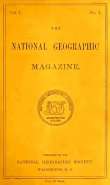
The National Geographic Magazine, Vol. I., No. 1, October, 1888

to show that continued research will in the future give us fresh forms of prediction and increase the usefulness of this branch of science to mankind.
In all departments of geographical knowledge, Americans are at work. They have pushed themselves into the front rank and they demand the best efforts of their countrymen to encourage and support.
When we embark on the great ocean of discovery, the horizon of the unknown advances with us and surrounds us wherever we go. The more we know, the greater we find is our ignorance. Because we know so little we have formed this society for the increase and diffusion of Geographical knowledge. Because our subject is so large we have organized the society into four broad sections: relating to the geography of the land, H. G. Ogden, vice-president; the sea, J. R. Bartlett, vice-president; the air, A. W. Greely, vice-president; the geographic distribution of life, C. H. Merriam, vice-president; to which we have added a fifth, relating to the abstract science of geographic art, including the art of map-making etc., A. H. Thompson, vice-president; our recording and corresponding secretaries are Henry Gannett and George Kennan.
We have been fortunate indeed to secure as Vice-Presidents men learned in each department, and who have been personally identified with the work of research.
GEOGRAPHIC METHODS IN GEOLOGIC INVESTIGATION.
Definition of Geography and Geology—Geographic Methods in Geology—Hutton and Lyell—Marine deposits explained by existing processes reveal the history of the earth—American Topographers—First Pennsylvania Survey; geographic form as the result of extinct processes—Western Surveys; geographic form explained by existing processes reveals the history of the earth—Deductive Topography—Comparison with Palæontology—Geographic Individuals—Classification according to structure—Ideal cycle of regular development—Interruptions in the Simple Ideal Cycle—Geography needs ideal types and technical terms—Comparison with the biological sciences—Teaching of Geography—The water-falls of Northeastern Pennsylvania as examples of deductive study—Systematic Geography.
The history of the earth includes among many things an account of its structure and form at successive times, of the processes by which changes in its structure and form have been produced, and of the causes of these processes. Geography is according to ordinary definition allowed of all this only an account of the present form of the earth, while geology takes all the rest, and it is too generally the case that even the present form of the earth is insufficiently examined by geographers. Geographic morphology, or topography, is not yet developed into a science. Some writers seem to think it a division of geology, while geologists are as a rule too much occupied with other matters to give it the attention it deserves. It is not worth while to embarrass one's study by too much definition of its subdivisions, but it is clearly advisable in this case to take such steps as shall hasten a critical and minute examination of the form of the earth's surface by geographers, and to this end it may serve a useful purpose to enlarge the limited definition of geography, as given above, and insist that it shall include not only a descriptive and statistical account of the present surface of the earth, but also a systematic classification of the features of the earth's surface, viewed as the results of certain processes, acting for various periods, at different ages, on divers structures. As Mackinder of Oxford has recently expressed it, geography is the study of the present in the light of the past. When thus conceived it forms a fitting complement to geology, which, as defined by the same author, is the study of the past in the light of the present. The studies are inseparable and up to a certain point, their physical aspects may be well followed together, under such a name as physiography. Specialization may then lead the student more to one subject than to the other.
An illustration from human history, where the study of the past and present has a single name, may serve to make my meaning clear in regard to the relation of the two parts of terrestrial history, which have different names. A descriptive and statistical account of a people as at present existing, such as that which our statistical atlas of the last Census gives in outline, corresponds to geography in its ordinary limitation. A reasonable extension of such an account, introducing a consideration of antecedent conditions and events, for the purpose of throwing light on existing relations, represents an expanded conception of geography. The minute study of the rise and present condition of any single industry would correspond to the monographic account of the development of any simple group of geographic forms. On the other hand, history taken in its more general aspects, including an inquiry into the causes and processes of the rise and fall of ancient nations, answers to geology; and an account of some brief past stage of history is the equivalent of paleography, a subject at present very little studied and seemingly destined always to escape sharp determination. It is manifest that geology and geography thus defined are parts of a single great subject, and must not be considered independently.
History became a science when it outgrew mere narration and searched for the causes of the facts narrated; when it ceased to accept old narratives as absolute records and judged them by criteria derived from our knowledge of human nature as we see it at present, but modified to accord with past conditions.
Geology became a science when it adopted geographic methods. The interpretation of the past by means of a study of the present proves to be the only safe method of geologic investigation. Hutton and Lyell may be named as the prominent leaders of this school and if we admit a reasonable modification of their too pronounced uniformitarianism, all modern geologists are their followers. The discovery of the conservation and correlation of energy gives additional support to their thesis by ruling out the gratuitous assumption of great results from vague causes. Causes must be shown to be not only appropriate in quality, but sufficient in quantity before they can be safely accepted. But the geographic argument as expounded by the English school deals almost entirely with processes and neglects a large class of results that follow from these processes. Much attention is given to the methods of transferring the waste of the land to the sea and depositing it there in stratified masses, from which the history of ancient lands is determined. But the forms assumed by the wasting land have not been sufficiently examined. It was recognized in a general way that land forms were the product of denudation, but the enormous volume of material that had been washed off of the lands was hardly appreciated, and the great significance of the forms developed during the destruction of the land was not perceived.
Hutton says a little about the relation of topography to structure; Lyell says less. The systematic study of topography is largely American. There is opportunity for it in this country that is not easily found in Europe. The advance in this study has been made in two distinct steps: first, in the East about 1840; second, in the West about 1870. The first step was taken in that historic decade when our early State surveys accomplished their great work. The Pennsylvania surveyors then developed topography into a science, as Lesley tells us so eloquently in his rare little book "Coal and its Topography," 1856, which deserves to be brought more to the attention of the younger geographers and geologists of to-day. It presents in brief and picturesque form the