


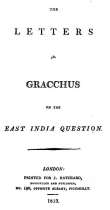
قراءة كتاب The Letters of Gracchus on the East India Question
تنويه: تعرض هنا نبذة من اول ١٠ صفحات فقط من الكتاب الالكتروني، لقراءة الكتاب كاملا اضغط على الزر “اشتر الآن"

have now proposed, that merchants should be restricted to such ports as can best afford the means of guarding against the depredations of smuggling.
The regulations, which were adopted for ships importing from India to the out-ports, are to be found in the Act 9 and 10 William III. c. 44. s. 69. and were as follows:—
"Provided always, and it is here enacted, that no Company, or particular person or persons, who shall have a right, in pursuance of this Act, to trade to the East Indies, or other parts within the limits aforesaid, shall be allowed to trade, until sufficient security shall be first given (which the Commissioners of the Customs in England, or any three or more of them for the time being, are hereby authorized and required to take, in the name and to the use of His Majesty, his heirs and successors), that such Company, or particular persons, shall cause all the goods, wares, merchandise, and commodities, which shall at any time or times hereafter, during the continuance of this Act, be laden by or for them, or any of them, or for their, or any of their accounts, in any ship or ships whatsoever, bound from the said East Indies, or parts within the limits aforesaid, to be brought (without breaking bulk), to some port of England or Wales, and there be unladen and put to land, &c. And that all goods and merchandises belonging to the Company aforesaid, or any other traders to the East Indies, and which shall be imported into England or Wales, as aforesaid, pursuant to this Act, shall by them be sold openly and publicly, by inch of candle, upon their respective accounts, and not otherwise."
Upon this Act of the 9th and 10th of William III. was built, in the following year, that famous Charter of the Company, upon which they rest the weight of their pretensions; and that very Charter, as is here rendered incontestable by the Act itself, comprehended the principle, of an Import Trade from India to the OUT-PORTS of the kingdom.
The form and condition of the security which was to be given by the out-port merchants, will be found in the Act, 6th Anne, c. 3. entitled, "An Act for better securing the duties on East India goods." By that Act, the security to be given was fixed "at the rate of 2500l. sterling for every hundred ton their ships or vessels shall be respectively let for;" and the only restriction imposed upon the import trade from India was, that it should be brought "to some port in Great Britain."
Thus, then, any man who looks but a little beyond the objects which lie accidentally before his eyes, may see, that the measure now suggested by Government, instead of being a wild and airy speculation, a theoretical innovation, a new, untried, and dangerous experiment, on which we have no ground to reason from experience (as it has been ignorantly and falsely asserted), is nothing more than reverting to an ancient principle, involved in the Company's applauded Charter of the 10th of William the Third, and to the practice of our forefathers in the brightest period of our domestic history; a period, in which the British Constitution received its last perfection, and from which the present power and greatness of the British Empire, in the East and in the West, dates its origin.
Having sufficiently proved and established this great fact, let us next inquire, what history reveals to us, of the consequences of that import trade to the out-ports, that can tend, in any degree, to justify, or give support to, the Company, in determining to resort to an alternative which, they acknowledge, will subvert the system of Indian Government (and thereby shake the Constitution at home), rather than renew the measure of a regulated trade to the out-ports.
We have not to deduce these consequences from abstract hypothesis, but from historical testimony; let us, then, observe what that testimony unfolds. No evil, of any kind whatever, resulted to the incorporated, or Joint Stock Company, from the privilege enjoyed by the out ports. On the contrary, that Joint Stock Company, issuing out of the General Society of Merchants (which, as has been above stated, soon became the English East India Company), rose above all their competitors, notwithstanding the power of importing, without limitation, to any of the ports of the kingdom; and such was the rapidity of their progress, that they overcame the former, or London Company; they obtained a surrender of all their rights to St. Helena, Bombay, and all their other islands and settlements in India; they at length received that ancient Company into their own body; and finally became the United East India Company of the present day. And so little did the competition and free import of the general merchants tend to obstruct the growth of the United Company, even in the age of its infancy; and so "superior were the advantages they derived from trading with a joint-stock (to use the words of one of the Company's most strenuous champions), that at the time of the union of the two Companies, out of the whole loan of two millions, only 7000l. then remained the property of the separate traders of the General Society; and this sum also was soon absorbed in the United Company[4]." If then the Company, starting originally with only a joint stock, against a competition in the out-ports of the kingdom, with a power to import to those out-ports, outstripped and overcame all their competitors; what can they seriously apprehend from a renewal of the same experiment, in the present momentum of their power, and when they are able to unite with their joint-stock, the whole of the revenues of their present empire in the East?
But it may be asked, if no better success is likely to attend the commercial speculations of the out-ports, why is so strong an effort made, to admit them to a share in the India trade? The answer is obvious. When Mr. Dundas, in the year 1800, so forcibly expressed his opinion against any such admission, he did not ground that opinion upon a question of ports, but of commercial capital. He considered the capital of the Company as sufficient for all the advantage which the Public, in the aggregate, could derive from the India Trade; and he maintained, that the aggregate interest of the Public would suffer from any measure, tending "to divert any larger proportion of the commercial capital of the country from a more advantageous and more profitable use." But the circumstances of the world are become materially altered, since the period of 1800. The commercial capital, of which Mr. Dundas then reasoned, is deprived of that advantageous and profitable employment which his argument supposed, and is therefore without application or direction; from whence it has resulted, that the operation of commerce is interrupted, and its activity suspended. The allowing that capital to be partially directed to the markets of India, would therefore, under present circumstances, have the great national advantage, of recovering the activity and spirit of commerce, and of encouraging an extensive public interest which is at present disappointed, if not dormant; and, whenever a more prosperous state of things should return, the capital so engaged for a time, would, from the nature of commerce, unquestionably recall itself, and seek again a more profitable market, if any such should open. In the mean time,