

You are here

قراءة كتاب Secret Armies The New Technique of Nazi Warfare
تنويه: تعرض هنا نبذة من اول ١٠ صفحات فقط من الكتاب الالكتروني، لقراءة الكتاب كاملا اضغط على الزر “اشتر الآن"
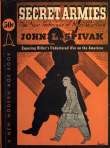
Secret Armies The New Technique of Nazi Warfare

essential to further aggressions. Instead of helping to put a troubled Europe on the road to lasting peace, Munich strengthened the totalitarian powers, especially Germany, and a strengthened Germany inevitably means increased activities of the Nazis' Fifth Column which is, in all quarters of the globe, actively preparing the ground for Hitler's greater plans.
If we can divine the future by the past, the Fifth Column, that shadowy group of secret agents now entrenched in every important country throughout the world, is an omen of what is to come. Before Germany marched into Austria, that unhappy country witnessed a large influx of Fifth Column members. In Czechoslovakia, especially in those months before the Republic's heart was handed to Hitler on a platter, there was a tremendous increase in the numbers and activities of agents sent into the Central European country.
During my stay there in the brief period immediately preceding the "peace," I learned a little about the operations of the Gestapo's secret agents in Czechoslovakia. Their numbers are vast and those few of whom I learned, are infinitesimal to the actual numbers at work then and now, not only in Czechoslovakia but in other countries. What I learned of those few, however, shows how the Gestapo, the Nazi secret service, operates in its ruthless drive.
For years Hitler had laid plans to fight, if he had to, for Czechoslovakia, whose natural mountain barriers and man-made defensive line of steel and concrete stood in the way of his announced drive to the Ukrainian wheat fields. In preparation for the day when he might have to fight for its control, he sent into the Republic a host of spies, provocateurs, propagandists and saboteurs to establish themselves, make contacts, carry on propaganda and build a machine which would be invaluable in time of war.
In a few instances I learned the details of the Nazis' inexorable determination and their inhuman indifference to the lives of even their own agents.
Arno Oertel, alias Harald Half, was a thin, white-faced spy trained in two Gestapo schools for Fifth Column work. Oertel was given a German passport by Richter, the Gestapo district chief at Bischofswerda on what was then the Czechoslovak-German frontier.
"You will proceed to Prague," Richter instructed him, "and lose yourself in the city. As soon as it is safe, go to Langenau near Boehmisch-Leipa and report to Frau Anna Suchy.[2] She will give you further instructions."
Oertel nodded. It was his first important espionage job—assigned to him after the twenty-five-year-old secret agent had finished his intensive course in the special Gestapo training school in Zossen (Brandenburg), one of the many schools established by the Nazi secret service to train agents for various activities.
After his graduation Oertel had been given minor practical training in politically disruptive work in anti-fascist organizations across the Czech border where he had posed as a German emigré. There he had shown such aptitude that his Gestapo chief at sector headquarters in Dresden, Herr Geissler, sent him to Czechoslovakia on a special mission.
Oertel hesitated. "Naturally I'll take all possible precautions but—accidents may happen."
Richter nodded. "If you are caught and arrested, demand to see the German Consul immediately," he said. "If you are in a bad predicament, we'll request your extradition on a criminal charge—burglary with arms, attempted murder—some non-political crime. We've got a treaty with Czechoslovakia to extradite Germans accused of criminal acts but—" The Gestapo chief opened the top drawer of his desk and took a small capsule from a box. "If you find yourself in an utterly hopeless situation, swallow this."
He handed the pellet to the nervous young man.
"Cyanide," Richter said. "Tie it up in a knot in your handkerchief. It will not be taken from you if you are arrested. There is always an opportunity while being searched to take it."
Oertel tied the pellet in a corner of his handkerchief and placed it in his breast pocket.
"You are to make two reports," Richter continued. "One for Frau Suchy, the other for the contact in Prague. She'll get you in touch with him."
Anna Suchy, when Oertel reported to her, gave him specific orders: "On August 16 [1937], at five o'clock in the afternoon, you will sit on a bench near the fountain in Karlsplatz in Prague. A man dressed in a gray suit, gray hat, with a blue handkerchief showing from the breast pocket of his coat, will ask you for a light for his cigarette. Give him the light and accept a cigarette from the gentleman. He will give you detailed instructions on what to do and how to meet the Prague contact to whom in turn you will report."
At the appointed hour Oertel sat on a bench staring at the fountain, watching men and women strolling and chatting cheerfully on the way to meet friends for late afternoon coffee. Occasionally he looked at the afternoon papers lying on the bench beside him. He felt that he was being watched but he saw no one in a gray suit with a blue handkerchief. He wiped his forehead with his handkerchief, partly because of the heat, partly because of nervousness. As he held the handkerchief he could feel the tightly bound capsule.
Precisely at five he noticed a man in a gray suit with a gray hat and a blue handkerchief in the breast pocket of his coat, strolling toward him. As the man approached he took out a package of cigarettes, selected one and searched his pockets for a light. Stopping before Oertel, he doffed his hat and smilingly asked for a light. Oertel produced his lighter and the other in turn offered him a cigarette. He sat down on the bench.
"Report once a week," he said abruptly, puffing at his cigarette and staring at two children playing in the sunshine which flooded Karlsplatz. He stretched his feet like a man relaxing after a hard day's work. "Deliver reports to Frau Suchy personally. One week she will come to Prague, the next you go to her. Deliver a copy of your report to the English missionary, Vicar Robert Smith, who lives at 31 Karlsplatz."
Smith, to whom the unidentified man in the gray suit told Oertel to report, was a minister of the Church of Scotland in Prague, a British subject with influential connections not only with English-speaking people but with Czech government officials.[3] Besides his ministerial work, the Reverend Smith led an amateur orchestra group giving free concerts for German emigrés. On his clerical recommendation, he got German "emigré" women into England as house servants for British government officials and army officers.
The far-flung Gestapo network in Czechoslovakia concentrated much of its activities along the former German-Czech border. In Prague, even today when Germany has achieved what she said was all she wanted in Europe, the network reaches into all branches of the Government, the military forces and emigré anti-fascist groups. The country, before it was cut to pieces and even now, is honeycombed with Gestapo agents sent from Germany with false passports or smuggled across the border.
Often the Gestapo uses Czech citizens whose relatives are in Germany and upon whom pressure is put. The work of these agents consists not only of ferreting out military information regarding Czech defense measures and establishing contacts with Czech citizens for permanent espionage, but of the equally