

You are here

قراءة كتاب Secret Armies The New Technique of Nazi Warfare
تنويه: تعرض هنا نبذة من اول ١٠ صفحات فقط من الكتاب الالكتروني، لقراءة الكتاب كاملا اضغط على الزر “اشتر الآن"
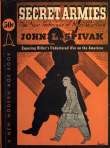
Secret Armies The New Technique of Nazi Warfare

support, that France was ready to give it, but that England refused, thereby forcing France to keep out of it.
While these frantic maneuvers were going on, the Astor-controlled Times and Observer, the Nazi and the Italian press simultaneously started a campaign against Eden. The date set for the sacrifice of Austria was approaching and Eden had to go or it might fail. The public, however, was with Eden; so another kind of attack was launched. Stories began to appear about the Foreign Secretary's health. There were sighs, long faces, sad regrets, but Eden stuck to his post in the hope that he could do something. On February 19, Hitler, tired of waiting, bluntly demanded that he be removed, and with the newspaper campaign in full swing, Chamberlain "in response to public opinion" removed him the very next day.
The amiable Lord Halifax was appointed Foreign Secretary. Pro-fascists like A.L. Lennon-Boyd, stanch supporter of Franco and admirer of Hitler and Mussolini, were given ministerial posts.
The Austrian invasion was delayed for three weeks because of the difficulty in getting Eden out. When the news flashed to a startled world that Nazi troops were thundering into a country whose independence Hitler had promised to respect, M. Corbin, the still unsuspecting French Ambassador, rushed to the Foreign Office to arrange for swift joint action. This was at four o'clock in the afternoon of March 11, 1938. Instead of receiving him immediately, Lord Halifax kept him waiting until nine o'clock in the evening. By that time Austria was Nazi territory. There was nothing to do but protest; so Lord Halifax, with a straight face, joined France in a "strong protest." It was not until a week after Austria had been absorbed that the French Intelligence Service learned the details of the Halifax deal and finally understood why England had side-stepped the pleas for joint action and why the French Ambassador had been kept cooling his heels until the occupation of Austria was completed.
From Austria Hitler got more men for his army, large deposits of magnesite, timber forests and enormous water-power resources for electricity. From Czechoslovakia, if he could get it, Hitler would have the Skoda armament works, one of the biggest in the world, factories in the Sudeten area, be next door to Hungarian wheat and Rumanian oil, dominate the Balkans, destroy potential Russian air and troop bases in Central Europe, and place Nazi troops within a few miles of the Soviet border and the Ukrainian wheat fields he has eyed so long.
Five days after Austria was invaded, on March 16, at 3:30 in the afternoon, Lord Halifax personally summoned the Czechoslovakian Minister. At four o'clock the Minister came out of the conference with a dazed and bewildered air. Lord Halifax had made some "suggestions." Revealing complete ignorance of what had happened and was happening in Czechoslovakian politics, Halifax was nevertheless laying down the law.
It was obvious that the British Foreign Secretary was getting orders from someone else, for Halifax suggested that the Central European Republic try to conciliate Germany (which it had been doing for months) and that a German be taken into the cabinet (there were already three in it). On March 22 there was another meeting at which the Minister learned that Halifax wanted the Czech Government to take a Nazi into the cabinet—as Austria took Dr. Seyss-Inquart at Hitler's orders.
This pressure from England for Czechoslovakian Nazis to be given more power in the government was virtually telling the beleaguered little democracy to fashion a strong rope and hang itself. Subsequent events showed that Chamberlain personally supplied the rope.
Then came the historic week-end of March 26-27, 1938.
The walls of the small drawing room at Cliveden House are lined with shelves filled with books. The laughing and chatting guests had gathered there after a delightful dinner. For the Prime Minister of England to go through all sorts of contortions in a game of charades might prove a trifle undignified; so the hostess suggested that they play "musical chairs."
Everyone thought it was a splendid idea and men servants in their impressive blue liveries arranged the chairs in the required order, carefully spacing the distances between them. One of the laughing and bejeweled women took her place at the piano. In "musical chairs" there is one person more than the number of chairs. When the music starts the players march around the chairs. The moment the music stops everyone dives for the nearest chair leaving the extra person standing and subject to the hilarious jibes of the other players and those rooting from the bleachers. It's one of the ways statesmen relax.
The music started and the dour Prime Minister of the greatest empire in the world, the Minister in charge of the Empire's defense measures, the editor of England's most powerful newspaper, the Right Honorable Speaker of the House of Commons, the sister-in-law of England's leading fascist and several others started marching while the piano tinkled its challenging tune. The Prime Minister, perhaps because he is essentially conservative, marched cautiously and stepped quickly between the spaces while Lady Astor eyed him shrewdly and the others suppressed giggles. The Prime Minister tried to maintain at least the dignity of his banking background but managed "to look only a little porky" as one expressed it afterward. Suddenly the music stopped. Everyone lunged for the nearest chair. The Prime Minister managed to get one and plopped into it heavily.
After half an hour or so some of the strategic rulers of Great Britain got a little winded and quit. A conversation started on foreign affairs and most of the wives retired to another room. When the discussion was ended the little Cliveden house party had come to six major decisions which will change the face of the world if successfully carried through.
Those decisions (maneuvers to put some of them into effect have already begun) are:
1. To inform France that England will go to her aid if she is attacked, unless the attack results from a treaty obligation with another power.
2. To introduce peace time conscription in England.
3. To appoint three ministers to coordinate industrial defense (conscription in peace time); supervise military conscription; and, coordinate the "political education of the people" (propaganda).
4. To reach an agreement with Italy to preserve the legitimate interest of both countries in the Mediterranean.
5. To discuss mutual problems with Germany.
6. To express the hope to Germany that her methods of self-assertion be such as will not hinder mutual discussions by arousing British public opinion against her.
The two most important decisions in this plan are the one for the conscription of labor in peace time and the effort to force France to break the Franco-Soviet pact by choosing between England and Russia.
Consider conscription first and the motives behind it:
When any country whose workers are strongly organized starts veering towards fascism, it must either win over the trade-unions in one way or another or destroy them, for rebellious labor can prevent fascism by means of the general strike. British labor is known to hate fascism since it has learned that fascism destroys, among other things, the value of the trade-unions and all that they have gained after many years of struggle. Any veering by England toward fascism and fascist alliances spells trouble with the trade-unions; hence, the decision "to coordinate the political education of the people." This move is particularly necessary since some trade-union leaders, especially in the important armament industry, have already stated publicly that unless the workers were given