

You are here

قراءة كتاب Famous Indian Chiefs Their Battles, Treaties, Sieges, and Struggles with the Whites for the Possession of America
تنويه: تعرض هنا نبذة من اول ١٠ صفحات فقط من الكتاب الالكتروني، لقراءة الكتاب كاملا اضغط على الزر “اشتر الآن"
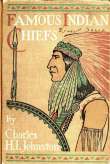
Famous Indian Chiefs Their Battles, Treaties, Sieges, and Struggles with the Whites for the Possession of America

FAMOUS INDIAN
CHIEFS
Their battles, treaties, sieges, and struggles
with the whites for the possession
of America
By
CHARLES H. L. JOHNSTON
Author of "Famous Cavalry Leaders," etc.
Illustrated

BOSTON. L. C. PAGE &
COMPANY. PUBLISHERS
Copyright, 1909
By L. C. Page & Company
(INCORPORATED)
All rights reserved
First Impression, November, 1909
Second Impression, September, 1910
Third Impression, September, 1911
Printed by
THE COLONIAL PRESS:
C. H. Simonds & Co., Boston, U.S.A.
Dedicated
To All Schoolboys and Young Men
INTRODUCTORY
Upon a beautiful day in July, 1492, two brown-skinned Spaniards lay upon the wharf that jutted far out into the waters of the blue Mediterranean Ocean at Palos, Spain, and looked meditatively in the direction of the far West. From their dress it could be easily seen that they were sailors, and from their conversation it was only too evident that they were speculating upon questions that then stirred the thoughts of many intelligent seafarers.
"As you watch a ship, its hull first disappears upon the horizon, then the spars, and then the masts, themselves," said one, "which leads me to the belief that mayhap we shall—in some of our voyages—come to a point where we shall fall from the centre of the earth and disappear into the heat of a fiery furnace."
The other smiled. "I am of that opinion myself," he answered, "but I do not feel the same fear of toppling off from the edge of things when I am on inland water, for in the Caspian Sea I have found that there is an end to all water courses and bodies of water that are of smaller size than that before us. In maps, I see that gnomes, dragons, hydras, and fire-breathing snakes are pictured in the unexplored distances. Serpents of great size and ferocity are supposed to live in the fiery caldron before us. Virgil, himself, speaks of them, and, as for myself, I wish that I might have the opportunity of seeing what is beyond the coast of Africa, which is the farthest point that I have ever reached in some fifteen years of wandering upon the ocean. 'Tis said that Cathay, by some called China, lies beyond the horizon, and is a land full of intelligent people ruled over by the mighty Khan."
"Well," continued the first, "I think that your wish to view the other world will soon be fulfilled, for rumor has it that Christopher Columbus—whom some say is half crazy with ideas that this world is round, and other strange fancies—is soon going to be able to take a trip across the sea, lying in front of us. Friends tell me that he has, at last, obtained money and ships from the King and Queen, and that he is about to venture forth in search of Cathay. You must hurry, my friend, if you would join his crew, for men tell me that the idea is popular, and that many wish to take passage with him."
The second seaman leaped to his feet. "I will go at once and see if I cannot get a place," he said, and, without more ado, he walked hastily to the narrow street which led into the town.
Not many weeks later, three little caravels: The Nina, The Pinta, and The Santa Maria, left their anchorage in front of the quaint seaport of Palos, and, propelled by a gentle breeze, made off towards the Straits of Gibraltar. On board was Christopher Columbus: dreamer, navigator, astronomer, mathematician, and the first white man to leave a record of a trip to the West Indies. The two Spaniards who had lain upon the wharf of Palos were with him, and, with spirits filled with the hope of new and strange adventures, the steersmen guided the vessels towards the unknown West.
Eventually the keen-eyed mariners sighted land, and, thinking that they had arrived at India, the Spaniards called the natives Indians, when they had reached the shore and were surrounded by copper-colored people. These savages were, at first, greatly afraid of the fair-haired strangers and refused to meet them on friendly terms, but, after they understood that the voyageurs would not injure them, they began to barter and trade in a friendly and intimate manner.
The natives wore no clothing and had their bodies painted with grotesque designs, and in various colors. They were armed with lances, tipped with beads of sharp flint and fish bones, or hardened at the end by being charred in a fire. Of iron and steel they apparently had no knowledge, for one venturesome brave seized one of the swords of the Spaniards and severely cut his own hand with it, which proved conclusively that they were not accustomed to this form of a weapon. With cries of pleasure they received the glass beads, pieces of lead, and other trinkets which Columbus and his men gave to them, and, in return, offered the Spaniards tame parrots, cavassa bread (of their own baking) and long rolls of cotton yarn. But these presents did not particularly interest the white adventurers, as they were not only in search of a route to India, but also for the shining and alluring particles of gold.
In their noses the Indians wore small, golden ornaments which were of far greater interests to the greedy invaders than were the tame parrots. So much so, indeed, that Columbus and his men immediately made inquiries regarding the source from which the natives secured such treasure. They were told that these articles came from the southwest, where lived a powerful Monarch who was accustomed to have his meals served upon dishes of fine, beaten gold. This stimulated the spirits of the invaders to penetrate into the unknown distance, for they were confident that they had reached the outlying islands of Asia and were near a famous deposit of riches of which other Spanish travellers had written.
The daring Columbus had reached San Salvador—a beautiful isle of the West Indies—which was surrounded by other fertile islands, covered with palms and luxurious foliage, from which came the chatter of parrots, the cries of tropical birds of brilliant plumage, and the sweet scent of flowers and of fruit. As the Indians were not molested they became more friendly, and it was easier to understand their signs and gesticulations. From these the Spaniards learned that they were in the midst of an archipelago—or collection of islands—and that there were more than a hundred of these, inhabited by people who were continually at war with one another—a state of affairs that exactly tallied with what Columbus had heard of the islands upon the coast of Asia. He was therefore convinced that he was in a land which had been previously explored by Spanish voyageurs, and that he had found what he had set out from Spain to discover—a new and more direct route from the mother country to the East Indies and the Chinese Empire.
Columbus weighed anchor and kept sailing from one island to another, hoping to find Cathay, or China. But temples, palaces, and cities did not appear. In their stead, frail houses of bark and