

You are here

قراءة كتاب Famous Indian Chiefs Their Battles, Treaties, Sieges, and Struggles with the Whites for the Possession of America
تنويه: تعرض هنا نبذة من اول ١٠ صفحات فقط من الكتاب الالكتروني، لقراءة الكتاب كاملا اضغط على الزر “اشتر الآن"
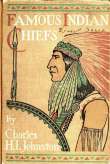
Famous Indian Chiefs Their Battles, Treaties, Sieges, and Struggles with the Whites for the Possession of America

dressed in a handsome fur robe, and leaning upon a pillow embossed with brilliant embroidery of shells and beads. The chief men of the village were assembled before him and four or five hundred of the tribe stood on guard behind them. A proclamation was made to the effect that upon pain of death no Indian should offer any discourtesy to either of the whites, while Powhatan renewed his acquaintance with Smith with much show of apparent affection. An English boy, named Savage, was given to the Indian Emperor at his request, and he returned the favor by presenting to Captain Newport an Indian youth called Nomontack, who was one of his most trusted servants, and who was told to spy upon all methods and customs of the English. Three or four days were passed in feasting, dancing, and trading, in which the old Sachem exhibited so much dignity and discretion that his guests had a high admiration for his talents. His shrewdness was well exhibited when Newport endeavored to barter with him for some corn.
The English Captain had brought with him a number of trinkets, glass beads, and pewter spoons which he expected to trade very easily for corn, and, indeed, the poorer Indians traded very readily with him. But they dealt upon a very small scale as they had not much to spare, so Newport became most anxious to drive a trade with the Emperor, himself, and endeavored to do so.
"Captain Newport," said Powhatan, "it is not agreeable to my greatness to truck and peddle for trifles. I am a great Werowance and I esteem you the same; therefore lay all your trading commodities down together and what I like I will take, and in return you shall receive what I consider to be a fair value therefore."
As Newport could not speak the Indian tongue, this was interpreted to him by Smith, who told him, at the same time, that he must be most careful in trading with the crafty Indian, and should not be too free in his dealings with him. But Newport was a vain fellow and felt that he could easily hold his own with the Emperor and gain any request that he might make, so he placed all of his goods before Powhatan, who coolly selected those which he liked most, and gave him, in return, only a few bushels of corn when he had expected to obtain twenty hogsheads. "At this rate," interposed Captain Smith, "we might have purchased our corn in Old Spain, but now let me see if I cannot traffic with his excellency," and, so saying, he took out various trinkets which he flashed before the eyes of the aged Indian, in the light, so that they shone with an extraordinary lustre.
Powhatan's eyes rested upon a string of blue beads, and he became anxious to obtain them.
"These are such as only Kings and Nobles wear in our country," said Smith, "and of immense value. For a string of beads you must give me three hundred bushels of corn."
"That I cannot do," answered Powhatan, "but so desirous am I of having them that I will give you two hundred bushels."
"For two hundred and fifty bushels you can have them," answered Smith.
And so they haggled, until, in the end, the witty Captain Smith obtained somewhere between two and three hundred bushels of corn for a small and insignificant string of beads. Shortly afterwards the cunning Englishman made a similar trade with Opechancanough at Pamunkey, stating to him that these beads had in them the color of the sky and that they were composed of a most rare substance. This Indian likewise fell before the lure of the Captain's plausible and ready speech, and several hundred bushels of corn were secured for a pound or two of these beads, which now grew into such estimation among the Indians, far and near, that none but the great Werowances and their wives and children dared to be seen wearing them. They were considered to be imperial symbols and of enormous value.
Although tricked in this transaction, Powhatan was bright enough to see that the English possessed a vast advantage over his own men whenever it came to a conflict, for they had swords and muskets, whereas his savage followers only possessed bows, spears, and arrows. He knew that if he obtained possession of these he would be able to place himself upon an equal footing with the Colonists and would also be able to domineer over the less fortunate Indian tribes of Virginia. Consequently when he learned that Captain Newport was to leave for England, he sent him twenty-five turkeys and requested, in return, the favor of an equal number of swords. Newport was sufficiently inconsiderate to furnish them to him, but these were not enough for Powhatan, who, soon afterwards, sent a number of turkeys to Smith. The Captain was keen enough to see through the trick of the old gentleman, and, although he thanked him for his kindness with a courteous note, he sent no swords in return. Powhatan was highly offended at this and told his followers to steal the Englishmen's swords whenever they could—an order which they began to obey with such good effect that Smith ordered every Indian caught stealing to be tied, severely whipped, and kept captive. The Emperor of the Virginia savages now saw that the game was a desperate one and so sent Pocahontas into Jamestown with various presents and kind speeches to excuse himself for the injury done by his disorderly warriors and to request that those who were captives might be liberated. Smith took this under consideration and finally granted the Emperor's request, "for the sake of Pocahontas, his daughter," dispatching the captured warriors back to Powhatan's village, where the Indian counsellors were much offended at what they considered to be the cruelty of the white man, and adjured Powhatan to seek revenge. The Emperor affected to be satisfied and would take no action.
Newport had sailed for England, and in September, 1608, arrived with a second supply for the colony and a paper authorizing him to make an expedition of exploration for gold among the Monocan Indians, who resided in the Blue Ridge. For this a barge was brought out from England which could be separated into five parts and thus carried around the falls of the Potomac, and thence convey the explorers (as was supposed in England) to the South Sea. It had been decided by the London company, in England, to crown Powhatan and present him with a basin and ewer, a bedstead, bedding, and various other costly novelties. Captain Smith offered to carry them to Powhatan at We-ro-woco-moco and to invite him to visit Jamestown, for Newport was anxious to obtain a quantity of corn in order to feed his followers in search for the South Sea.