

You are here

قراءة كتاب A Desk-Book of Errors in English Including Notes on Colloquialisms and Slang to be Avoided in Conversation
تنويه: تعرض هنا نبذة من اول ١٠ صفحات فقط من الكتاب الالكتروني، لقراءة الكتاب كاملا اضغط على الزر “اشتر الآن"
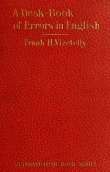
A Desk-Book of Errors in English Including Notes on Colloquialisms and Slang to be Avoided in Conversation

A Desk-Book of
Errors in English
Including Notes on Colloquialisms and Slang to be Avoided in Conversation
By Frank H. Vizetelly, Litt.D., LL.D.
Managing Editor of “Funk & Wagnalls New Standard Dictionary of the English Language”; Author of “Essentials of English Speech and Literature,” Etc.
A REVISED EDITION

FUNK & WAGNALLS COMPANY
NEW YORK and LONDON
Copyright, 1906 and 1920, by
FUNK & WAGNALLS COMPANY
[Printed in the United States of America]
Copyright Under the Articles of the Copyright Convention
of the Pan-American Republics and the United States,
August 11, 1910
Published January 1, 1920
All Rights Reserved
PREFACE
The fact that this little book has passed through many editions, and now enters on a new one in revised form, is ample answer to its writer’s prayer when, with the aid of his Publishers, he launched it on an uncertain voyage over the seas of time—
It is with sincere gratitude to the Publishers that the author acknowledges the results achieved to have been due wholly to their kindly interest and indefatigable efforts. He ventures to hope that this new edition, and such subsequent editions as time may require, will be found to measure fully up to the expectations of the discriminating Public on which it depends for support.
F. H. V.
New York, January, 1920.
INTRODUCTORY
In these days when the vernacular of the street invades the home; when illiterate communications corrupt good grammar; and when the efforts of the teachers in the public schools are rendered ineffective by parents careless of their diction, constant attempts are being made to point out the way to that “Well of English undefiled” so dear to the heart of the purist. But, notwithstanding these efforts to correct careless diction, the abuse and misuse of words continue. The one besetting sin of the English-speaking people is a tendency to use colloquial inelegancies, slang, and vulgarisms, and against these, as against the illiteracies of the street, it is our duty to guard, nowadays more so than at any other time, since what is learnt in the schoolroom is soon forgotten or displaced by association with illiterate playfellows, or by occasionally hearing words misused at home.
Of the purely syntactical side of the English language, no less a master of its intricacies and niceties than Thomas Jefferson has said “I am not a friend to a scrupulous purism of style; I readily sacrifice the niceties of syntax to euphony and strength. It is by boldly neglecting the rigorisms of grammar that Tacitus has made himself the strongest writer in the world. The hyperesthetics call him barbarous; but I should be sorry to exchange his barbarisms for their wiredrawn purisms. Some of his sentences are as strong as language can make them. Had he scrupulously filled up the whole of their syntax, they would have been merely common. To explain my meaning by an English example, I will quote the motto of one, I believe, of the regicides, of Charles I., ‘Rebellion to tyrants is obedience to God.’ Correct its syntax ‘Rebellion against tyrants is obedience to God.’ It has lost all the strength and beauty of the antithesis.” And Jefferson continued: “Where strictness of grammar does not weaken expression, it should be attended to. But where, by small grammatical negligences, the energy of an idea is condensed, or a word stands for a sentence, I hold grammatical rigor in contempt.”
The English language is the most flexible language in the world. Indeed, it is so flexible that some of its idioms are positively startling. Could any phrase be more so than “I don’t think it will rain”?—Simple enough as an idiom but positively absurd when analyzed. We say “I don’t think it will rain” when we mean “I do think it will not rain.” Again, we say “All over the world” when we should say “Over all the world,” and “the reason why” instead of “the reason that.” Usage has made our language what it is; grammatical rules strive to limit it to what it ought to be. In many instances usage has supplanted grammatical rules. Hundreds of words have been used by masters of English in ways that violate these rules. These uses are to be found to-day recorded by the dictionaries because lexicographers recognize it is their duty to present the language as they find it used by the people. It is to the people, not to the purists, that one must look for the enriching of our mother tongue. To them it is as impossible to confine the English language within the bonds of grammatical rules as it is to stem the tide of the sea. For them all matters that relate to English speech can be decided only by the law of good usage. This, and this alone is their Court of Last Resort. Withal, the observance of certain conventional rules does no harm if it helps him who speaks carelessly to produce a refined style of diction and writing, or if it teaches him who does not know, what to say and how to say it.
The secret of strength in speech and writing lies in the art of using the right word in the right place; therefore, careful speakers and writers should aim to command not only a large vocabulary but a wide and correct knowledge of the meanings of words. These can be most readily acquired by noting the meaning of every new word across which one may come in reading, and by constantly consulting a dictionary, preferably one which compares or contrasts words in such a manner as to bring out clearly the finer and nicer distinctions in their meanings—such distinctions as are necessary to the student to put him into possession of the essential differences of the words compared. Learn the meaning of words and your tongue will never slip. As Southey has said, “the greatest wisdom of speech is to know when, and what, and where to speak; the time, matter, and manner.”
The best asset in life is knowledge. Knowledge well-grounded may be secured by the systematic study of words. The desirability of exercising great care not only in the selection of words, but in marshaling them in their correct order must be apparent to any one familiar with some of the errors committed by writers who, notwithstanding the blunders they have made, have acquired reputation as authors of good English. Dr. Samuel Johnson, in his “Lives of the Poets,” is responsible for the following statement: “Shakespeare has not only shown human nature as it is, but as it would be found in situations to which it cannot be exposed”—a