

You are here

قراءة كتاب Burning of the Brooklyn Theatre A thrilling personal experience! Brooklyn's horror. Wholesale holocaust at the Brooklyn, New York, Theatre, on the night of December 5th, 1876
تنويه: تعرض هنا نبذة من اول ١٠ صفحات فقط من الكتاب الالكتروني، لقراءة الكتاب كاملا اضغط على الزر “اشتر الآن"
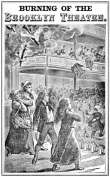
Burning of the Brooklyn Theatre A thrilling personal experience! Brooklyn's horror. Wholesale holocaust at the Brooklyn, New York, Theatre, on the night of December 5th, 1876

scene through, Mrs. Farren (Frochard) entering meanwhile. The carpenters were all the while trying to stop the progress of the flames, unnoticed by the house, and Miss Claxton delivered her little speech to Jacques: “I forbid you to touch me,” which was greeted with applause. Meanwhile the audience had begun to suspect something, and with Miss Claxton’s words, “I will beg no more,” the actors were forced to move from fear of falling timber, and the audience rose to their feet. Mrs. Farren and Mr. Murdoch stepped to the footlights and waved to the people to resume their seats, while Mr. Studley and Miss Claxton went forward to do likewise. Mr. Studley shouted: “Ladies and gentlemen, there will be no more of the play, of course; you can all go out if you will only keep quiet.” Miss Claxton, at the other end of the stage, begged the people to keep cool, adding: “We are between you and the flames.”
By this time the fire (which seems to have originated by some of the “short drops” blowing against the “border lights” in the flies, and so communicating to the scenery) had made so much headway that the actors had to look out for themselves. They had held their ground as long as it was possible, and, seeing from the panic which started immediately in the gallery and spread all over the upper part of the house, that the worst had begun, they began their retreat, the ground floor being already almost cleared. Mr. Thorne had gone. Mr. Burroughs was up-stairs in his dressing-room, from which he escaped only to meet his death. Mr. Murdoch was never seen again. Miss Claxton and Miss Harrison rushed one way; Miss Girard and the minor people another.
The sight of fire seemed to paralyze every one for an instant, and just as they recovered sufficiently to act, Mr. Studley’s sudden coming to the front of the stage and assuring them that there was no cause for alarm caused another pause of a second. It was for a second only. The blazing fragments began falling thick and fast, contradicting the actor’s well-intentioned deception. The audience arose as by one impulse and made a rush for the doors. The entreaties of Miss Claxton and Mr. Murdoch were unheeded. The fierce struggle for life had begun.
The ushers for the most part preserved their presence of mind and endeavored to enforce order among the rushing crowd, as did also the police in attendance. Mr. Rochfert, the head usher, broke open a small door at the farther end of the vestibule and increased the facilities of exit into the open air, which regularly consisted of two doors five feet wide, opening upon Washington street. Mr. Rochfert also entered the auditorium and endeavored to quell the excitement, but without effect.
A fire alarm had been immediately sent from the First Precinct Station-House, which is located next the theatre, and a minute or two after a general alarm and also a call for the reserved force of all the precincts. But by the time the engines were in position and at work the fire was beyond control. The occupants of the orchestra chairs and parquet had had but little difficulty in making good their escape, but at least two-thirds and perhaps even a larger fraction of the audience were still in the dress-circle and gallery. The lowest estimate of the number in the gallery is that five or six hundred people were in that portion of the house, and from among these were most of the three hundred deaths. The exit from the first balcony was down a single flight of stairs in the rear of the vestibule. Down these stairs the people came in scores, leaping and jumping in wild confusion. The way out from the upper gallery was down a short flight of stairs starting from the south wall of the building, thence by a short turn down a long flight against the same wall to the level of the balcony, and from this floor down a cased flight into Washington street. The main floor and first balcony were soon emptied through their respective exits, but for the five or six hundred panic-stricken gallery spectators to pass safely through the tortuous passage described was next to an impossibility. Every indication points to the belief that, suffocated by the smoke forced down like a wall from the roof, the mass of those in the upper gallery thronged about the entrance to the stairs and were either blocked there so as to make exit impossible, or were unable even to make the attempt to escape, and sank down, one upon the other, to fall in a mass into the horrible pit under the vestibule when the supports of the gallery were burned away. Those near the entrance of the stairs were, probably, the only ones who were able to escape from this terrible slaughter-pen. There was comparatively little outcry here, and this again would seem to indicate that suffocation had intervened to numb the sensibilities of the hundreds to whom death was to come by fire.
As soon as the flames reached the rear of the theatre, near the entrances, where the hundreds of people were contending wildly, the horror of the scene was increased tenfold. Some leaped madly from the gallery upon the orchestra chairs, and only a few were sufficiently self-possessed to lower themselves by the railings. One man escaped by the small window at the head of the gallery stairs, letting himself down upon the roof of the station-house. Another, who attempted the same escape, was suffocated or became insensible as he reached the window, and was seen sitting motionless there until swept away. A few lowered themselves from the second-story windows on the Flood’s alley side. But the great mass stood helplessly blocked in. The smoke became unbearable, and the police and firemen who had been able to penetrate the crowd at all were obliged to retire. They seized as many of the paralyzed bodies as they could and dragged them into the street, passing on their way out over piles of insensible men and boys. Fifteen minutes after the fire broke out the interior of the theatre was wrapped in flames. Shortly after the roof fell in, and, at 11.45, a half an hour after the fire started, the broad east wall fell with a terrible crash. The few who had reached the first flight of stairs from the street were taken out and carried into the First Precinct Station-House. The crowd that had escaped from the theatre remained in the adjacent streets. Men without hats or coats, with clothing torn and faces bruised; women bonnetless and dishevelled, weeping convulsively—every face was a picture of woe and fright.
The crowd was quickly and largely augmented by the anxious throng of sight-seers, and to keep them within the proper limits required the efforts of nearly the entire reserved police force of the city. The Police Commissioners and Superintendent Campbell, and Inspector Waddy; the Chief of the Fire Department, Thomas F. Nevins, and Fire Marshal Keady, had been telegraphed for and came promptly to the scene of the conflagration, and did everything in their power to provide for the sufferers, for many had been brought out bruised and burned. The firemen had not fairly begun their labors before it became evident that it was impossible to save the theatre or any part of it; the entire attention of the force was therefore directed to the surrounding buildings, which meanwhile were seriously threatened. Several small buildings on the opposite side of Flood’s alley were partially destroyed, and at one time the First Precinct Station-House was in imminent danger. The fire was, however, confined to the theatre by the united exertions of the entire fire department. The interior decorations of the theatre were of such light and inflammable material that the fire was quite beyond their control, so far as the theatre was concerned, and the roof being equally light and inflammable, it required constant exertion to keep the fire