

You are here

قراءة كتاب Burning of the Brooklyn Theatre A thrilling personal experience! Brooklyn's horror. Wholesale holocaust at the Brooklyn, New York, Theatre, on the night of December 5th, 1876
تنويه: تعرض هنا نبذة من اول ١٠ صفحات فقط من الكتاب الالكتروني، لقراءة الكتاب كاملا اضغط على الزر “اشتر الآن"
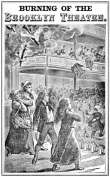
Burning of the Brooklyn Theatre A thrilling personal experience! Brooklyn's horror. Wholesale holocaust at the Brooklyn, New York, Theatre, on the night of December 5th, 1876

from spreading.

CLAUDE BURROUGHS. H. S. MURDOCH.
At about three o’clock in the morning the fire had been nearly extinguished, and the major part of the throng of sight-seers had gone to their homes, ignorant of the fatal consequences of the conflagration.
The flames had subsided sufficiently to permit the firemen to make an investigation near the main entrance of the theatre. Chief Nevins passed over the trembling floor of the hallway toward the inner doorway. Inside the doors the flooring had fallen in, leaving a deep pit of fire and flame, from which a dense smoke and steam ascended. Here a sickening spectacle met his horrified gaze. Close up to the flaming furnace, and clinging to the splintered verge of the demolished flooring, was the body of a woman. Her hands clasped the frame-work of the door in a desperate grasp. She had fought hard for life. Evidently she would have escaped had not the flooring given way beneath her. All the clothing was burnt off, and the features were so blackened that she was unrecognizable, and the body was removed to the Morgue.
At 4 o’clock in the morning the flames were put out, and the heap of debris was black and cold. From the vestibule platform the firemen saw a most horrible spectacle. The mound that had at first appeared to be simply a heap of ashes proved to be almost wholly composed of human bodies. Heads, arms, legs, shoulders, shoes, and here and there entire human remains protruded through the surface of the mound. Policemen and firemen hesitated for a moment before leaping down upon the sickening heap. An inclined plane of plain deal boards was hastily constructed to reach from the tender vestibule platform to the pit, and upon this a ladder was rested. Upon the ladder the men went to and fro. Upon the plane, coffins were hauled up and down. At first the firemen lifted the bodies from the debris, after having carefully dug around them and loosened them, and ten minutes was consumed in exhuming each body. But as it became apparent that there were scores and scores of human remains, and that a day, and perhaps a night, would end before the last corpse was taken out, less tender means were used in the operation, and the work assumed a more earnest and energetic character. Instead of five men, ten men set at work among the ruins, while on the vestibule platform a dozen sturdy firemen manned the short ropes by which the coffins, laden with human remains, were drawn up and dragged to the sidewalk. All the bodies were bent into horrid shapes, assumed in the struggles of death by suffocation and by burning. Nine out of ten of the corpses had an arm upraised and bent to shield the face. Something was missing from every one. This one lacked a head or a foot, this a nose, an ear, or a hand, another its fingers or the crown of the skull. Very many broken limbs and protruding bones were found, and there were gashes in the upturned faces or fractures in the smooth-burned skulls, so that each corpse as it was dragged into the light was a new revelation of ghastliness. A few lusty pulls disengaged each body. Two or three men seized its stiffened limbs and pressed them into a coffin, a pair of sharp-pointed tongs clutched the coffin, and the firemen overhead dragged it even with the street, where a cloth was thrown over the coffin, and it was dragged to the dead-wagons, which kept coming and going all day long.
Opera glasses, chains, studs, purses, and even watches were found under and on the bodies, and were thrown to one side upon a spread-out newspaper. Opposite the main entrance at the rear of the theatre other firemen and police officers delved in the ashes and brought forth corpse after corpse to be boxed and carried away to the Morgue, with the same rapidity as at the other door. At four o’clock, when a hundred and forty-seven bodies had been exhumed on the Washington street side, fifty-three had been carried from the alley-way in the rear. Moving among the firemen, either as spectators or supervisors of the ghastly work, were Chief Engineer Nevins, Police Commissioner Hurd, Fire Commissioner McLaughlin, Assistant Engineer Farley, and ex-Police Superintendent Folk.
Surrounding the ruins, in Washington, Johnson and Adams streets, were throngs of people who stood close together on the sidewalks and left only room enough for one vehicle at a time to traverse the roadways. The dead-wagons continually passing and repassing, kept this passage way clear, and were themselves the objects of the most interest. During the entire day there were continual quarrels between the police officers and the over-curious people. Pickpockets—nearly all boys—were numerous, and were brought into the First Precinct station two at a time. In the station were coats, and hats, canes, shawls, bundles, valises filled with costumes, and numerous other articles taken from the ruins of the theatre.
When the first wagon, laden with the dead from the fire, halted in front of the Morgue, the gathering pressed forward and crushed its way between the wagon and the doorway. The police officers appealed to the people to be calm, and at length the bodies were taken into the building.
Daylight had not set in when the arrival of the dead bodies was announced. It was thought at first that the first was the remains of a young woman, but a vest displaying a watch and chain was revealed. About nine o’clock the second body, that of a young man whose hands were clasped, and who wore a plain silver ring and a gutta percha ring, was received. Nicholas Kieley’s remains were next, and the Rev. Father Kieley, who wept as though his heart was broken, recognized his brother.
Upon the body of the fourth corpse was a gold open-faced watch, to which was attached a thin gold chain. On the back of the watch was the words, “A mother’s gift.” The fifth body was that of a stalwart man, whose hands were fixed over his face. Then there was a negro whose features were beyond recognition. Following was a body whose head had been nearly consumed, and next one whose arms had been burned away. On this man was a bright gold collar button. Then there were the remains of a young woman. The limbs were drawn up, the body was twisted, and the features could not be recognized.
The remains of a boy about fourteen years of age were next carried in. A man with a checked shirt was put at his side. The bodies of three young boys and three girls were next received. On one of the bodies was a hunting-case silver watch, 76,744, with a gold chain and a piece of the Hell Gate telegraphic wire as a charm. The timepiece was in good order and marked the correct time.
Before 3 o’clock seventy-eight bodies were strewn about in the Morgue, and a long line of men and women were constantly passing in and out of the building. Nearly every person had permits from the Coroner’s office, and the women visitors were in the majority.
A most shameful and vulgar feature of the inroad upon the Morgue was the vast number of women who, through mere curiosity, insisted upon entering the building. Women who were naturally nervous and hysterical forced their way in and risked good clothing and head dress in their wild attempts to hover over the bodies. They began to sob and gesticulate long before they reached the hallway in which twenty-three blackened corpses were in line on the marble floor.
When the women reached this scene they shrieked as though bereft of all their kindred, but the majority of them were forced to admit that they knew no one among the dead. Occasionally some agonized mother or wife recognized the charred remains of a loved one, and the woman wept as only a woman can weep.
Keeper McGuire, who has witnessed much