

You are here

قراءة كتاب Burning of the Brooklyn Theatre A thrilling personal experience! Brooklyn's horror. Wholesale holocaust at the Brooklyn, New York, Theatre, on the night of December 5th, 1876
تنويه: تعرض هنا نبذة من اول ١٠ صفحات فقط من الكتاب الالكتروني، لقراءة الكتاب كاملا اضغط على الزر “اشتر الآن"
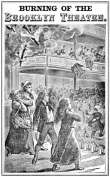
Burning of the Brooklyn Theatre A thrilling personal experience! Brooklyn's horror. Wholesale holocaust at the Brooklyn, New York, Theatre, on the night of December 5th, 1876

sorrow in his place, and who is supposed to have a heart of adamant, wiped tears from his eyes, and then tried to excuse himself by saying: “This is too much. I am almost unnerved.”
Occasionally some plain, methodical person entered, and, through close searching, discovered one who was known to him. In a business-like way the discoverer pinned a card or a slip of paper, bearing the man’s name, to what remained of the clothing. Young and giddy girls, who should have been chastised for their impudence, flaunted themselves in the presence of distressed visitors, and seemed to enjoy their trip through the Morgue.
On each side of the building is a yard, and there are many windows. Small boys and stalwart men peered through these windows and indulged in expressions that were unseemly. This outside rabble became so unruly that an additional force of police was called upon to prevent a crush into the building.
None of the bodies were put on the slabs. All were on the flooring. The faces were so blackened by the fire that they could not be recognized, and it was only through clothing or jewelry that any were identified. The undertakers of Brooklyn combined together and volunteered their services in behalf of the sorrow-stricken families. They were of very great assistance to the police in preventing professional mourners from robbing the dead. One woman recognized her brother when she discovered a stud in his shirt bosom. Another woman, with a small piece of cloth and a piece of shirt bosom, identified her husband, and saying, “He has $100 in his pockets,” put her hand in his vest pocket and took therefrom that amount.
The arms of nearly all the dead were fixed as though shielding their faces, and one woman had drawn her clothing over her face and clinched her hands above her forehead. Two young men were grappled together as though they had had a personal encounter in an attempt to escape from the theatre. Others lay on their sides in the manner of persons who thus slumber. Their watch chains and other jewelry were beautifully bright, and the clothing of all was blackened through the fire.
In only about one-third of the cases were the limbs exposed through the torn and burned clothing. Uplifted hands, whose fingers were shining bones, bore golden rings, and shoeless feet glistened in their whiteness. The hair and whiskers were gone, and faces were terribly scarred. A few of the bodies were burned to a crisp, and these were put into rough pine boxes, and all hope for their identification was given up.
Until late in the afternoon, men, women, and children flocked to the Washington street station to tell of fathers, husbands, brothers, and children who had not returned to their homes since the evening previous. Hour by hour the list of missing persons increased in numbers until it comprised nearly 200 names. All who made inquiry for friends or relatives were necessarily disappointed, for the blackened, charred bodies were few of them in a condition to be identified. Strong men, who had kept up both heart and hope, broke down and sobbed like women when they learned their own flesh and blood might never be discovered from out of the scores of shapeless trunks that were being exhumed from the ruins. Women came in sobbing and went away convulsed with grief. The policemen themselves often surrendered their forced self-possession and sobbed aloud.
In the evening the work was continued by the aid of calcium lights. It was thought best to discontinue the removal of the bodies from the rear through Theatre alley to Myrtle avenue. Sixty-seven in all had been taken out that way. The main entrance, with the ghastly burdens still regularly coming out of it, was thrown into bold relief. The burner and lantern had been knocked off the street lamp over the way, and a great flame of gas blazed and flared into the air, lighting up the scorched and splintered doorway and the upturned faces of the throng. A calcium light on the sidewalk near the door illumined the corridor to the point where the floor had broken, and there another was fixed whose rays shone directly into the deep pit in which the earlier search had discovered the horrible mass of charred human bodies.
This pit was the cellar of the main corridor, and its ruins were separated from the debris in the auditorium by the strong foundation wall that had borne the gallery columns. It was not until nine o’clock that this cellar, about twelve feet wide, and running through to the foundation wall on the alley side, was cleared. Over one hundred and fifty bodies had been removed from it.
Toward the rear fewer were found, and those were evidently not from the gallery, as fragments of kid gloves could be seen on the fingers of the blackened hands, some of which still clutched opera-glasses. These bodies were more thoroughly calcined than those first found, and not unfrequently the firemen were able to put two or three into one box.
After dark the orders against admitting outsiders to the ruins were more strictly enforced. Among those admitted was the foreman of the Grand Jury, W. W. Shumway. A calcium light from the alley wall shone over the ruins of the auditorium, and here the firemen began work shortly after nine o’clock. In addition to the lime light, oil lamps with reflectors and lanterns were used.
In this fitful glare the firemen, their faces pallid from fatigue and hunger, toiled on without a word. The first body found in the auditorium was on the Theatre alley side. Its position indicates that the victim had reached a window when he was struck down.
Some friends of Mr. Murdoch were very anxious that an early effort should be made to recover his body. His mother was expected to arrive in the city during the evening, he having sent for her a few days before. About nine o’clock a stream of water was put upon the ruins in the northeast corner to cool the immense pile of bricks under which the body was thought to lie.
The firemen were greatly impeded by the clouds of steam. They made their way from the southern end toward the stage. The broken wall lay in great lumps of brick and mortar. About halfway toward the stage shapeless human flesh was found crushed between two huge masses which had protected it from the flames that had consumed all the rest of the body. It was long before the bricks could be sufficiently cooled to admit the removal of this fragment. It was feared all the bodies in this part of the ruins had been similarly or more thoroughly consumed, owing to the intense heat from the inflammable stage fixtures.
The interior of the Adams Street Market presented at night a weirdly horrible sight. Disuse had made the place grimy. The gas fixtures had been removed, and candle light had to be used. The bodies were in rows that reached the entire length of the long apartment. On the breast of each was a lighted candle held in a small block of wood. Candles were also stuck on the hooks that had once been used to hang meat on, and lanterns helped to illuminate the spacious place; but the combined light was not sufficient to rid the corners of dark shadows. The bodies were in strained shapes, as though death had stopped them in a writhing struggle. Their arms were raised to their faces in most instances, the gesture suggesting suffocation or warding off heat. The charring made them appalling to look at. At an old counter officers added to lists the names of the few who were from time to time identified.
Articles taken from the bodies were in a basket, enveloped and numbered, and corresponding numbers were written on slips of paper and pinned to the rags that still clung to the corpses. Men and women passed from body to body, seeking friends or relatives, examining the bits of clothing, holding the candles close to the blackened faces, and looking for scars or other marks that might make recognition possible. They were wonderfully composed in manner, the only outbreaks