

You are here

قراءة كتاب Burning of the Brooklyn Theatre A thrilling personal experience! Brooklyn's horror. Wholesale holocaust at the Brooklyn, New York, Theatre, on the night of December 5th, 1876
تنويه: تعرض هنا نبذة من اول ١٠ صفحات فقط من الكتاب الالكتروني، لقراءة الكتاب كاملا اضغط على الزر “اشتر الآن"
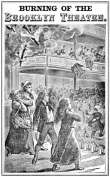
Burning of the Brooklyn Theatre A thrilling personal experience! Brooklyn's horror. Wholesale holocaust at the Brooklyn, New York, Theatre, on the night of December 5th, 1876

for its oppressive gloom, the deadly cold, the grief on every hand; but that portion from Sixth avenue to the gate of Greenwood Cemetery was in all respects the worst. All that way the roll of the muffled drums continued, and across the wide vacant spaces toward the bay the icy blast seemed the breath of death itself.
Battle Hill, where the arrangements for the interment of the bodies in one common grave had already been made, is the highest point of ground in the cemetery, and is situated but a short distance from the gate by which the procession entered. Here a circular trench had been cut, seven feet deep and thirteen feet wide, nearly surrounding a round sodded space ten feet in diameter, upon which the projected monument is to stand.
It soon became evident that human endurance would be insufficient to bear any protraction of the obsequies. With wonderful fortitude, not less than 2,000 persons maintained their places about the enormous grave, held as if by a hideous fascination. But all were suffering intensely from cold, and it was determined by those in charge to make the services as brief as possible.
The Rev. John Parker read the Protestant Episcopal burial service. The Rev. Dr. Putnam, instead of the extended funeral oration which he had prepared for the occasion, announced that the extreme cold would preclude the possibility of its delivery, and merely said a few brief words on the uncertainty of life and the blessed hopes of immortality. Then the benediction was pronounced by the Rev. Mr. Odell, and the ceremony concluded with the singing by the Germania choir of Kuhlau’s beautiful choral, “Above all summits there is repose.”
Besides the public funeral, many private ones, of persons who had been identified by friends, took place on Saturday, Sunday and Monday.
The bodies of the actors Murdoch and Burroughs were taken to Irving Hall at 1 o’clock on Saturday, and remained in state until the funeral on Sunday.
Great festoons of crape hung in long curves from a common centre in the middle of the room reaching to the galleries, that were draped in funeral cloth. Each end of the hall bore its burden of black. Two circles of gas in the ceiling cast a melancholy radiance. The bodies were encased in two rosewood coffins mounted with silver, which were placed in the centre of the room. The coffins severally bore the inscriptions:
CLAUDE DE BLENAU BURROUGHS,
Born Aug. 12, 1848; died Dec. 5, 1876.
HENRY S. MURDOCH,
Died Dec. 5, 1876, aged 31.
Crosses and wreaths, the gifts of friends, covered the lid of each. At their head was placed a stand containing a large scroll of white flowers with the word “Arcadian” in violet, the tribute of the members of the former club of that name. There was also a rich offering from the Order of Elks, with the mystic initials of the order predominant. As soon as the bodies were placed in position friends began to pass by the coffins. They continued to do so in the afternoon and evening. During the night the bodies were watched by a committee, the members of which relieved each other at intervals.
The funeral services were held in the Church of the Transfiguration, better known as “The Little Church Around the Corner.” The services were very impressive, and the attendance was very large. Dr. Houghton conducted. The remains of Mr. Burroughs were placed in the receiving vault of the Second Street Cemetery, and those of Mr. Murdoch were taken to Philadelphia, and buried on Monday in Woodland Cemetery, the funeral services being conducted in St. Peter’s P. E. Church.
Mr. Murdoch’s Career on the Stage.
Mr. Henry S. Murdoch, one of the victims of the terrible calamity, was engaged in the cast of the “Two Orphans” as Pierre, the cripple, and was the sole support of a widowed mother and two sisters, who reside in Philadelphia. The latter were expected in Brooklyn next week to visit their brother during the Christmas holidays. Mr. Murdoch was born in Boston, August 5, 1845, and was consequently in the thirty-second year of his age. He received his education in Philadelphia, and made his début at the Arch Street Theatre, in that city, in the winter of 1864. During the season of 1865 he fulfilled an engagement at the Boston Museum, and from there he went to Cincinnati, where he performed at Pike’s Opera-house until its destruction by fire on March 22, 1866. In this case he narrowly escaped with his life, and lost his entire wardrobe in the fire. He next went to San Francisco, where he played with John McCullough at the California Theatre. He remained there two years—1867-8. He then performed short engagements in Washington, Baltimore, St. Louis and Pittsburgh. In 1872-3 he played at the Arch Street Theatre, Philadelphia, under the management of Mrs. John Drew, taking the parts of “fop” and “walking gentleman,” and upon one or two occasions played leading characters. The season of 1873-4 he spent in Chicago, and acted at Hooley’s Theatre, under the management of Mr. Fred Williams, of Boston. He resigned his position before the close of the season to support Miss Clara Morris at the Academy of Music in the same city, then under the management of Mr. C. R. Gardner, who is now the manager of the Arch Street Theatre, Philadelphia, where Mr. Murdoch made his début. During his engagement with Miss Morris he made a decided hit as Armande, in the play of “Camille.” At the conclusion of his engagement in Chicago he returned to Boston, where he remained one season, and commenced his engagement with Messrs. Shook & Palmer last spring, when he played the part of Sandy Morton, in the play of “Two Men of Sandy Bar,” at the Union Square Theatre, New York. From there he went to the Brooklyn Theatre on October 9 last. Mr. Murdoch was a nephew of Mr. James E. Murdoch, the eminent tragedian, and a brother of Frank Murdoch, the author of “Davy Crockett.” He has a brother in New Orleans also an actor, whose stage name is William Wallace, and who lately made his début in that city. Mr. Murdoch was an accomplished and educated gentleman, and a rising actor. During his engagement in Boston he played such characters as Charles Middlewick, in the play of “Our Boys,” and Harry Spreadbrow, in “Sweethearts.” He gave much satisfaction in Brooklyn in his interpretation of Eustace, in “Conscience,” Charles Surface, in “School for Scandal,” and was giving an exceptionally good rendition of Pierre, the cripple, in the “Two Orphans,” at the time of the fire. He was a good vocalist and amateur artist. He had been suffering from sciatica for some time, and the malady had given him considerable pain during the six weeks previous to his tragic death, causing him to limp painfully at times. He occupied apartments at No. 53 Concord street, where his uncle, Mr. Henry Murdoch, resides.
Claude Burroughs.
Claude Burroughs first made his appearance on the stage at the Winter Garden, New York, in 1865, playing in “Hamlet” with Edwin Booth. At the conclusion of his engagement with Mr. Stuart, who was then managing the Winter Garden, he went to Brooklyn, where he played light comedy parts in the Park Theatre, then under Mrs. Conway’s management. Upon the opening of the Union Square Theatre by Messrs. Shook & Palmer Mr. Burroughs was engaged to play light parts. His first appearance at that theatre was as a reporter in “Agnes,” the first piece produced in the house, and he has been in the cast of nearly every play since produced there. Upon a few occasions when not playing in New York he has accepted engagements in Brooklyn. He was the fop in “Atherley Court,” the fop in “Jane Eyre,” Maxime in “Ferreol,” and a very clever representative of Talbot Champneys in “Our Boys.” At